• Skip to primary navigation
  • Skip to content
  • Skip to footer

We Made a Difference. We Made it Together. WEMADEIT.

  • About WEMADEIT
    • Donor
    • Partners
      • Toronto Metropolitan University
      • Ontario Tech University
      • University of Waterloo
      • Western University
  • For Students
    • Blog
    • Getting There
      • Engineering Disciplines
      • Student Life
      • Where Can I Study?
      • What You Don’t Know About Engineering
      • ENG BLING
    • Black Students
    • Indigenous Students
    • 2SLGBTQIA+ Students
    • Women and Girls
  • For Parents
    • Where Can You Study Engineering?
    • What is Engineering?
  • For Undergrads
    • Gaining work experience
    • Peer Mentorship
    • One Awards
    • Next Generation in Power
    • New Grad Program
  • For Teachers
    • Teacher Resources
  • Getting Involved
  • Contact Us
    • Newsletter Signup

Jobs in Engineering

Biomedical Engineering

by admin

Biomedical Engineering

What’s this career all about?

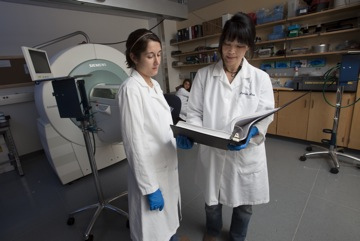
Biomedical engineers use their knowledge of engineering, medicine and biology to develop solutions to medical problems or procedures. They focus on different areas for providing an overall enhancement of health care to the society. Tissues, medical imaging, orthopedic surgery, biomechanics and genetic engineering are just a few of the many specialties. Biomedical engineers often need to work with experts from other fields like chemist, physician, surgeons and other specialists. The majority of the time they work in research labs as a team.
What kind of courses do Biomedical Engineers study in school?

  • Introduction to Medical Imaging and Applications
  • Bio-materials and Biocompatibility
  • Law and Ethics in Engineering Practise
  • Tissue & Rehabilitation Engineering

What are some cool projects that Biomedical Engineers get to work on?

  • Creating and designing prosthetic legs
  • Develop safe and accurate ultrasound technology to help doctors monitor babies in utero
  • Growing tissues that help repair damage from heart attacks
  • Relieving chronic neck pain and help children with cerebral palsy walk by creating an internal medication pump for anti-muscle-spasm drug

What are 5 qualities of a Biomedical Engineers?

  • Able to work effectively with people from various disciplines and educational backgrounds
  • Creativity
  • Strong Analytical Skills
  • Keen interest in positive health outcomes
  • Well-rounded academic interests

How do Biomedical Engineers contribute to making the world a better place?

Biomedical engineers contribute to the world by creating new devices and medication that can help those who need the assistance, such as those patients who need a heart transplant, pacemaker, or an artificial arm! They are always developing new creations to help enhance the quality of life for those around the world.


Filed Under: Engineering Disciplines Tagged With: career, future, Jobs in Engineering, types of engineering

Aerospace Engineering

by admin

Aerospace Engineering

What’s this career all about?

An Aerospace Engineer can do many things such as research, design, develop, maintain and test different types of airplanes, satellites and spaceships. They also work on the different components that make up these aircraft and systems.

There are two types of Aerospace Engineers;

  1. Aeronautical- they work on airplanes and helicopters; things that stay in the earth’s atmosphere.
  2. Astronautical- they work on rockets, space shuttles; basically, spacecraft things that are not in the earth’s atmosphere.

What kind of courses do Aerospace Engineers study in school?

  • Mechanism and vibrations
  • Flight mechanics
  • Computational Fluid Dynamics
  • Aircraft stability & control

What are some cool projects that Aerospace Engineers get to work on?

  • Designing the latest ground and aquatic transportation such as deep sea vessels and high-speed trains
  • Creating Spaceships to further explore our solar system
  • Designing airplane wings that change shape to enhance manoeuvrability
  • Creating more efficient space satellites to collect information in space, such as detecting drought
  • Creating guidelines and flight paths for astronauts and mission control

What are 5 qualities of an Aerospace Engineers?

  • Creativity
  • Excellent analytical and logical-thinking skills
  • Excellent knowledge of mathematics and physics
  • Communication
  • High proficiency in research methodology, experiments and data collection

How do Aerospace Engineers contribute to making the world a better place?

Aerospace engineers have changed our world through time by creating means to travel through air and by water to get around the world.

Through the use of their creativity and the laws of science, they have made means for use not only to travel inside our world but into outer space. With time aerospace engineers will surely be responsible for use travelling through galaxies. Without aerospace engineering going on vacation on another continent or even visiting your family in another country would have been impossible. Yet through the use of innovation, they are working every day to make our everyday modes of transportation safer and better for the future.

They design clean-burning jet engines, improved plasma displays, or super-efficient wind turbines to harvest wind energy.

Filed Under: Engineering Disciplines Tagged With: future, Jobs in Engineering, types of engineering

Erika Kiessner

by admin

Erika Kiessner

Q&A WITH EngHERO: Erika Kiessner

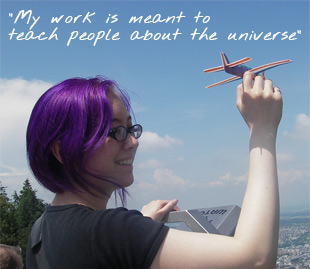
Erika Kiessner is an exhibit developer for an independent exhibit design and fabrication company. She creates all the cool interactive exhibits at places like the ROM or Ontario Science Centre!Erika Keissner Polaroid 2

Q: What’s one thing you wish you knew about engineering back when you were in high school?

I honestly wasn’t sure what I was getting into when I signed up for engineering. I just knew that it was a good place to go if you were good at math and interested in science. I guess I wish someone had told me how abstract it is. An engineering degree isn’t about learning a set of concrete skills. It is more about learning a set of mental tools and approaches for solving problems. Thankfully that toolkit can be useful in a lot of fields. I’m very glad that I did an internship as part of my degree. It showed me the kind of work that I wouldn’t be happy doing long term.

Q: What’s your proudest accomplishment as an engineer?

This question is hard since I don’t work as an engineer. I have done some work doing mechanical and electrical design for artists and I have developed some elegant systems for several art pieces. Ironically the mechanisms were all hidden away inside the pieces so no one but me could really appreciate them!

Q: Tell me about a time in your career when your work has been about discovery or curiosity?

I am very fortunate that most of my career has been about discovery and curiosity. I have done a lot of work for science museums and to properly design an exhibit to explain a concept you really need a deep understanding of that concept. Plus, one of my goals in designing a good exhibit is to get people curious. And to do that I have to be curious myself.

Q: What are you doing these days?

My job now is as an exhibit developer for a small independent exhibit design and fabrication firm called Aesthetec Studio, in Toronto. We do concept development, prototyping and electronics fabrication for exhibits for museums and other institutions. Basically anything interactive that is a hybrid of the digital and physical is in our wheel house. I started at the Ontario Science Centre as floor staff talking about science to visitors.

I knew before I graduated that I wasn’t interested in going into a traditional engineering job and through my undergraduate thesis, I got to know some people at the OSC. So I started on the floor and worked my way into designing exhibits, something I can definitely thank my engineering degree for.

I spent three years there developing new exhibits and that was where my career started. After the OSC I took a year to do a masters degree in Fine Arts, specializing in interaction design. This gave me another set of tools to apply to my practice and helped me look at my work in more than one way.

Q: Do you feel your work contributes to society? How so?

Absolutely. My work is meant to teach people about the universe and more importantly, get them excited about finding out how and why things work.

Q: Why do we need more female engineers?

I think there are two reasons. The first is that in any field that is involved in problem solving, the more perspectives that come to a problem the better scope the proposed solutions will have. The second is that engineering culture would be better served by having more women, for much the same reason.

Q: Why do you personally believe the statistics are the way they are in terms of females in engineering?

Not all of the streams of engineering have an unbalanced female to male ratio. At the University of Toronto, where I studied, chemical engineering was affectionately known as “Fem Eng” because it was predominantly women. Similarly, I would estimate that industrial engineering, the stream I studied was about 40% women. I believe computer engineering was a bit lower but the ones that really stood out were mechanical engineering and electrical engineering, in which there were far more men than women. So what I really wonder is why some types of engineering attract women and others do not.

Generally, I think males get more encouragement to be strong in math and science than women do. That is changing, I hope. I also think that females are more willing to assert themselves in these areas over any societal opposition, than they were a generation ago. The old guard is turning over into the new, and ever more women will get into engineering. At one time doctors were all men and now women are pretty much equally represented. I think engineering will go that way too.

– – – – – – – – – – – – – – – – – – – – – – – – – – – – – – – – – – – – – – – – – – – – – –
Check out Aesthetec Studio‘s work

Filed Under: Journeys Tagged With: education, ENGartist, exhibitdeveloper, Female Engineer, fun, indie, innovative, interactive, Interview, Jobs, Jobs in Engineering, Path to Engineering, unique, Women, Women's in Society

« Previous Page

Footer

Menu

  • About WEMADEIT
    • Donor
    • Partners
      • Toronto Metropolitan University
      • Ontario Tech University
      • University of Waterloo
      • Western University
  • For Students
    • Blog
    • Getting There
      • Engineering Disciplines
      • Student Life
      • Where Can I Study?
      • What You Don’t Know About Engineering
      • ENG BLING
    • Black Students
    • Indigenous Students
    • 2SLGBTQIA+ Students
    • Women and Girls
  • For Parents
    • Where Can You Study Engineering?
    • What is Engineering?
  • For Undergrads
    • Gaining work experience
    • Peer Mentorship
    • One Awards
    • Next Generation in Power
    • New Grad Program
  • For Teachers
    • Teacher Resources
  • Getting Involved
  • Contact Us
    • Newsletter Signup

Search

Teacher Login

Register | Lost your password?

  • Facebook
  • Instagram
  • Twitter

© 2026 · WEMADEIT | Site Design by rtraction