• Skip to primary navigation
  • Skip to content
  • Skip to footer

We Made a Difference. We Made it Together. WEMADEIT.

  • About WEMADEIT
    • Donor
    • Partners
      • Toronto Metropolitan University
      • Ontario Tech University
      • University of Waterloo
      • Western University
  • For Students
    • Blog
    • Getting There
      • Engineering Disciplines
      • Student Life
      • Where Can I Study?
      • What You Don’t Know About Engineering
      • ENG BLING
    • Black Students
    • Indigenous Students
    • 2SLGBTQIA+ Students
    • Women and Girls
  • For Parents
    • Where Can You Study Engineering?
    • What is Engineering?
  • For Undergrads
    • Gaining work experience
    • Peer Mentorship
    • One Awards
    • Next Generation in Power
    • New Grad Program
  • For Teachers
    • Teacher Resources
  • Getting Involved
  • Contact Us
    • Newsletter Signup

admin

Kim Farwell

by admin

Kim Farwell

Q&A WITH ENGHERO: Kim Farwell

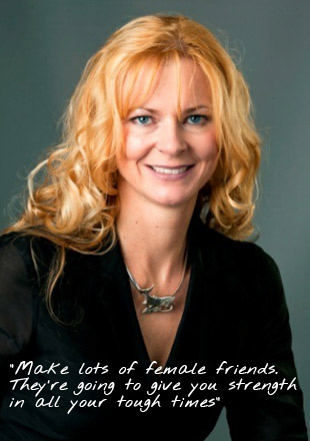
Kim is a senior technical advisor for extraction and she is the first female to reach this position in her company, Syncrude Canada Ltd. She got there by getting a chemical engineering degree, an MBA and a certificate in oil sands technology.
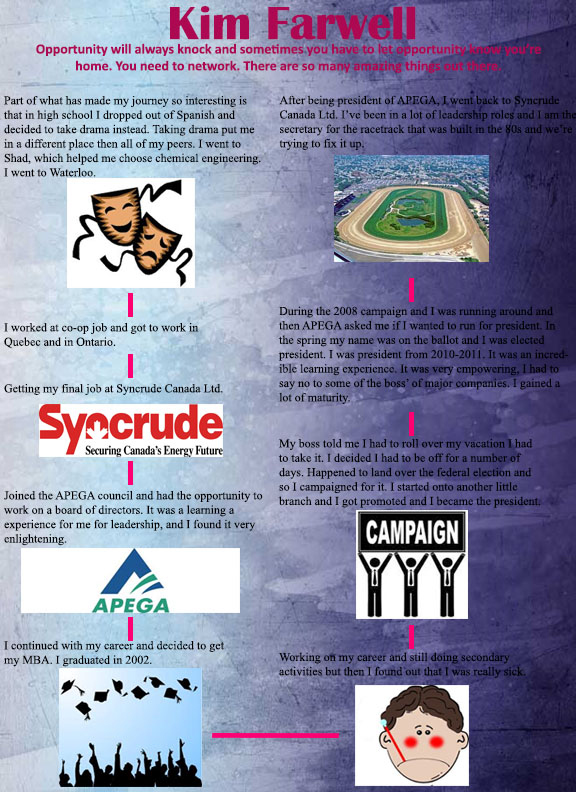
Kim Farwell Journey Map

Q: What’s one thing you wish you knew about engineering back when you were in high school?

I wish I knew that I was going to enjoy it as much as I do.

Q: What’s your proudest accomplishment as an engineer?

I’m proud of that I received the Early Accomplishment Award and was president of APEGA in 2010. I’m also proud of the time I figured out a very interesting technical problem at the plant.

Q: Tell me about a time in your career when your work has been about discovery or curiosity?

My work was about discovery and curiosity when I solved a problem at the plant. A geologist and I figured out why oils weren’t coming off the separator by applying the fundamentals we had learned to real life.

Q: What are you doing these days?

My job now is a senior technical advisor for extraction and I’m the first female to reach this position in my company, Syncrude Canada Ltd. I got there by getting a chemical engineering degree, an MBA and a certificate in oil sands technology. I also have a co-op degree with six work terms, all with different companies. When I started out in high school, I was planning to be a political journalist but my friend convinced me to enter a Popsicle stick bridge contest. We drilled holes in the Popsicle sticks, put ribbons through them and won.

This is when I really started to consider engineering as a career path. Also, I went to Shad Valley and I worked with Xerox to study a pigment used for photocopiers. This helped me realize that I wanted to work in the field of chemistry.

Q: Do you feel your work contributes to society? How so?

I do. I secure Canada’s energy future with every drop of oil. My work provides jobs and energy to the world-without any ethical issues like in Nigeria or environmental issues.

Q: Why do we need more female engineers?

We need more female engineers because engineering is very much a team effort. You need a team of diverse group of people so they can solve problems and female engineers bring a different skill set.

Q: If you could recommend something for girls in high school what would it be?

I would recommend that you make lots of female friends. They are going to give you strength in all your tough times, ground you when you’re being mistreated and encourage you to never give up.


Filed Under: Journeys Tagged With: AMAZING, engbeaut, inspirational, intelligent, Interesting, Kind, Nice, Outgoing, Smart

Laura Paul

by admin

Laura Paul

Q&A WITH EngHERO: Laura Paul

Laura Paul is a field engineer, and sustainability analyst working forLaura Paul Morrison Hershfield. Every day, Laura helps minimize the negative impacts buildings have on the environment and optimize the positive ones.

Q: What’s one thing you wish you knew about engineering back when you were in high school?

There are so many related fields you can work it rather than just typical design streams. There are lots of social sides to Engineering as well, rather than just purely technical work.

Q: What’s your proudest accomplishment as an engineer?

One of my proudest moments as an Engineer was getting my iron ring presented to me by my Grandfather, Malcolm Paul, who also was a Civil Engineer. The iron ring is worn by Engineers as a reminder of the ethical obligations associated with our work.

Q: Tell me about a time in your career when your work has been about discovery or curiosity?

When I first go out on a construction site as field engineer it was a time when everything was new, and I was learning a huge amount. I was able to take the theory I learned in school and put it into practice. I learned a lot about materials, and constructability, and how each individual component worked with others in a system. I would highly suggest for all Engineers to have experience in the field on a construction site.

Q: What are you doing these days?

Sustainability Analyst, Morrison Hershfield, I work doing LEED (Leadership in Energy and Environmental Design) consultancy and assessments, which includes helping designers reducing energy and water, choose less impactful materials, and improve the indoor environment for occupants (such as access to daylight and views).

I got here through experience on LEED projects, obtaining LEED Accredited Professional (LEED AP) accreditation with specialties in: Building Design and Construction, Existing Building Operations and Maintenance, and Neighbourhood Design

I didn’t really know where I was going when I started, but I was hired by a General Contractor, so if I hadn’t learned more about sustainability I likely would have been headed towards general Project Management on Building projects.

Q: Do you feel your work contributes to society? How so?

Absolutely. I think that the buildings we live and work in affect us immensely – from the way we feel, to how healthy we are, to how they impact nature and the environment. Working as a Sustainable Building Specialist allows me to minimize the negative impacts buildings have and optimize the positive ones.

Q: Why do we need more female engineers?

I think the perspective of women is unique from the perspective of men (not better or worse, just different) – and encouraging many different perspectives always enhances decision making.

Q: What does a typical day on the job look like?

A typical day on the job involves working and coordinating with a team.

Filed Under: engHEROES Tagged With: achieve, beautiful, cute, engbeaut, fun, hero, inspire, society, work

Eng Songs MEGAMIX #1

by admin

Eng Songs MEGAMIX #1

What’s better than music? Seriously though. You can’t think of anything! Well, maybe love. But can you dance to love!?

Here’s a bunch of tunes to inspire, inform, and act as soundtrack in your Eng World!

Beyonce – I Was Here

This is an inspiring song about making positive changes to make the world a better place.

They Might Be Giants – Meet the Elements


“I love They Might be Giants their songs are informative but actually awesome in an adorable cheesy way”

Vlog Brothers – I LOVE SCIENCE!


“Thank you for putting a good deal of my love into words.”

Lenka – Everything at Once


“not exactly about science, but this song could be a great example and inspiration showing that there is really no limit to anyone’s personality and who they choose to be.”

The Lab Song – Bruno Mars Parody


“Very funny and creative. A great way of thinking about science! :D”

Science Groove – The Nucleus I Like Best


“My teacher was singing this ahahahaaaaaa!”

Solve Me Maybe


“this parody to “Call Me Maybe” is awesome!”

Mr Parr – Electromagnetic Spectrum Song


“A song my science teacher showed us to get the order of the electromagnetic spectrum.”

Bil Nye the Science Guy – G-R-A-V-I-T-Y


“Bill Nye’s science songs are always the most funniest and the best! :D”

Filed Under: More2Life Tagged With: art, dancing, fun, life, more2life, music, science songs

The Technology of Touch

by admin

The Technology of Touch

Procrastinating? We’ve got just the thing! The YTT have pulled together a series of TED Talks that they LOVE. Grab some popcorn and get comfy, because you’re about to get seriously inspired by these amazing engineering projects.

What is this TED talk about?

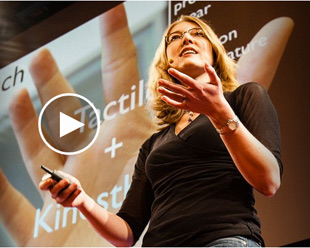
It’s about haptography, which is combining haptics (touch technology) with photography. The basis of this is that they can recreate the feeling of touching something using computers.

What’s amazing about it?

It’s really cool altogether! An example that the speaker gave was with dental students. They attached an accelerometer to a dental tool, and the main dental professor touches extracted teeth with it. The movements are recorded and recreated for the students. They watch a video and follow along by holding a repeating tool (which moves the same way the dental tool did).

How did it inspire you?

This is an incredible technology which has endless applications, anywhere from training dental and medical students to online shopping! It’s definitely going to become more popular and more developed as time goes on, but the implications of this technology are what inspires me. The possibilities are endless! People could do almost anything with this technology, which I find really interesting and inspiring.

What surprised you?

The main idea of it all, as weird as that sounds! I’d never heard of haptography before, and now, after hearing about it for a very brief time, I can only imagine the ways that it could be used. It’s so cool that there’s a technology that could allow you to feel like you’re touching something through a computer! I never knew that was even something that could be done!

Did you ever have an idea about developing something yourself that solves a problem in the world? Tell us all about it

I’ve thought about the idea for a technology where you could feel and smell things in a movie, TV show, or video game, but never really thought about the potential that it could be done. I never really thought about it that deeply, more as just an idea. If it could be done, however, it would be an incredible development for these forms of media. This wouldn’t solve a problem as much as it would just enrich movies, TV shows, and video games to make them better.

Filed Under: TED talk Tagged With: amazingENGprojects, crazycoolENG, haptography, inspirational, KatherineKuchenbecker, limitless potential, recreatingtouch, TheTechnologyOfTouch

Moving Sculpture

by admin

Moving Sculpture

Procrastinating? We’ve got just the thing! The YTT have pulled together a series of TED Talks that they LOVE. Grab some popcorn and get comfy, because you’re about to get seriously inspired by these amazing engineering projects.

What is this TED talk about?

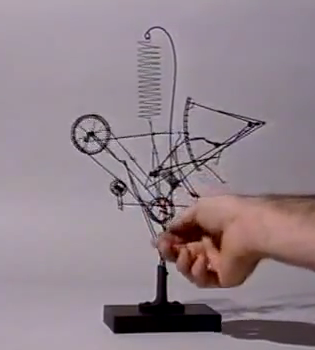
On a surface level this TED talk is about how a man fused his engineering and artistic sides together to create moving sculptures. On a deeper level this ted talk is about the moving cycle (like his work) of getting your internal aspirations to materialize and then how they are perceived by the external world.

What’s rad about it?

It is rad because it shows you a whole new area of engineering that I never thought about. It also manages to show how machines and the acute detailing attentiveness you need to create them are beautiful things.

How did it inspire you?

At first it made me feel very comfortable and sort of special in a way because I could relate to him about being an introverted person who communicated by physical creations. Then it further inspired me after I realized how he merged two strong passions of his together even though normally you wouldn’t think of them as one, it inspired me to listen to all my passions and try to find a way for them to work together like he did.

What surprised you?

What surprised me was my own reaction to his creations, normally I am someone who is not really into industrial or readymade art but I actually was very moved by how gracefully and intricately his machines worked and they always had a proactive function rather than a destructive one which is very nice especially in this era.

Did you ever have an idea about developing something yourself that solves a problem in the world? Tell us all about it

I’ve never really had a concrete idea of a product or invention that could change the world because I always thought since math and science weren’t my forte I wouldn’t be able to figure it out. But I have been thinking about programs I could start that would use yoga and poetry as the basis for attaining a holistic mindset and strength for those living in impoverished communities and empowering social change but I’m not sure yet how to do this because as someone from a middle class upbringing I don’t want to come off as ignorant and superficial to their real issues.

Filed Under: TED talk Tagged With: acceptance, art, artisticfusion, engspirational, eyefordetail, intricate, introvert, laENGartiste, machinesalive, movingsculpture beautiful

Erica Lee Garcia

by admin

Erica Lee Garcia

Q&A WITH EngHERO: Erica Lee Garcia

Engbeaut Erica Lee Garcia

Erica Lee is a professional engineer who not only provides professional consultation to engineering companies, but also uses her experience and abilities to help young engineering students/graduate get started in their career and also raises awareness about engineering alongside Engineers Without Borders.

Q: What’s one thing you wish you knew about engineering back when you were in high school?

I think that one thing would be that engineering is really different from math or science. Of course they are related and needed, but engineering itself is nothing like the educational experience. Engineering is fun! It’s about problem-solving, improvising, and teamwork. Also engineering helps people’s lives, make it safe, cost-effective.

Q: What’s your proudest accomplishment as an engineer?

I used to work in a mining company. I travelled to Africa and South America where there were a lot of mines and I was a speaker for workers of the company. I talked about a method similar to 6-sigma (later explained) and problem solving. Even though there were a lot of mines in some places, after all that can be drained is taken from the mine, there is no more work available and many lose their jobs. For me, it’s a proud accomplishment, because I got to visit them and train some people, and give them some skills that not only helped them save money at the present time, but also could be used for the rest of their lives, allowing them to solve problems.

Q: Tell me about a time in your career when your work has been about discovery or curiosity?

I used to work for a company called Magna which produces all sorts of car parts. When working in the factory, we had a problem where some of the parts did not fit together properly. Now each part was worth about $17, so if they were thrown out, that would be thousands of dollars per day. So I was put in charge of a group to try and solve this problem. In this group we used a 6-sigma method, where there are specific steps to follow; mainly we need to identify what the problem is, why does it matter, what are its causes, and finally find a solution. When we came up with a possible solution, we had to test them and collect data, like “how many bad ones now?” Finally, we realized that the problem came from the supplier of a specific part, where all of the parts were not identical, so we solved the problem by allowing a tighter window to our supplier. It was one of my first projects, and the problem we were working on was very subtle, so it felt good when we were able to solve it; and then I got started on a next project.

Engbeaut Erica Lee Garcia
Q: What are you doing these days?

My work is a combination of entrepreneurship and engineering. I am the president of my own company, Erica Lee Consulting, where we give our client companies advise on how to get better results while wasting less. I am also a coach/mentor for young engineering students or young engineers who have just graduated; it is really difficult when you have just graduated to know what the next step is, so we try and help them become more clear and confident with what they are going to do. And finally, I also work with Engineers Without Borders, where I talk to younger kids to help them understand their capabilities to make a difference in the world and make it better. I also help organizers of events for children to come up with different activities, where we’re talking to children in their own language, not ours.

Q: Do you feel your work contributes to society? How so?

For sure, in terms of my mentoring, I help young engineers gain clarity and confident and be happy with what they have chosen to do; it’s very important to enjoy what you do and be happy with your work. With the work I do in Engineers Without Borders, we can see the next generation as growing up with much greater understanding, empathy, and tolerance for complexity. They will care about sustainability when thinking of solutions and those kids are going to be 21st century problem solvers. Talking to children is something that other engineers can also volunteer to do, and it is coming that will have a great impact in the long run.

Q: Why do we need more female engineers?

I believe that engineering field needs to be as diverse as the population it serves. Because engineering and what it develops has a ripple effect, influence many other things around the world. Whenever you make something new, you need to consider the opinion of the stockholders and its sustainablitity, because it you don’t it won’t last long. Traditionally, we have had a lot of men in the field, and we have to fix a lot of problems; this doesn’t mean that men are to blame for these problems that we yet have to solve, but our resources are much better now and men have a specific type of intelligence. To have a balanced viewpoint, we need to have women who are commonly good at characteristics like empathy, creativity and caring. It’s easy to reach a decision when all people share the same opinions and are on the same page, but having one person who questions that decision is a must even though it can be tricky.
Also, it’s not just that we need a balance between men and women in engineering; engineering needs to have all different types of diversity, from background ethics to physical characteristics.

Q: Why did you choose to go into engineering?

I don’t really know how I chose engineering; there isn’t anyone in my family in engineering either. I know that I wanted to impact the physical world. Even as a kid, I was always looking for ways to optimize and do things better (for example, when it rained, I would go in the driveway and dig channels into the dirt to make the water flow better out of the driveway). For me, it was between going into engineering or music. I did not want to be a scientist, because I did not want to work with theories. But because I was good at math and science, school counsellors suggested and I chose to go into engineering. I believe that I made the right decision, because now I know that through engineering I am making a tangible impact, and from the beginning that was very important to me.

– – – – – – – – – – – – – – – – – – – – – – – – – – – – – – – – – – – – – – – – – – – – – –

View Erica’s Profile at EWB

Filed Under: engHEROES Tagged With: awareness, borders, children, consultant, engbeaut, engineering, future, graduate, inspirational, mentor, without, young minds

« Previous Page
Next Page »

Footer

Menu

  • About WEMADEIT
    • Donor
    • Partners
      • Toronto Metropolitan University
      • Ontario Tech University
      • University of Waterloo
      • Western University
  • For Students
    • Blog
    • Getting There
      • Engineering Disciplines
      • Student Life
      • Where Can I Study?
      • What You Don’t Know About Engineering
      • ENG BLING
    • Black Students
    • Indigenous Students
    • 2SLGBTQIA+ Students
    • Women and Girls
  • For Parents
    • Where Can You Study Engineering?
    • What is Engineering?
  • For Undergrads
    • Gaining work experience
    • Peer Mentorship
    • One Awards
    • Next Generation in Power
    • New Grad Program
  • For Teachers
    • Teacher Resources
  • Getting Involved
  • Contact Us
    • Newsletter Signup

Search

Teacher Login

Register | Lost your password?

  • Facebook
  • Instagram
  • Twitter

© 2026 · WEMADEIT | Site Design by rtraction