• Skip to primary navigation
  • Skip to content
  • Skip to footer

We Made a Difference. We Made it Together. WEMADEIT.

  • About WEMADEIT
    • Donor
    • Partners
      • Toronto Metropolitan University
      • Ontario Tech University
      • University of Waterloo
      • Western University
  • For Students
    • Blog
    • Getting There
      • Engineering Disciplines
      • Student Life
      • Where Can I Study?
      • What You Don’t Know About Engineering
      • ENG BLING
    • Black Students
    • Indigenous Students
    • 2SLGBTQIA+ Students
    • Women and Girls
  • For Parents
    • Where Can You Study Engineering?
    • What is Engineering?
  • For Undergrads
    • Gaining work experience
    • Peer Mentorship
    • One Awards
    • Next Generation in Power
    • New Grad Program
  • For Teachers
    • Teacher Resources
  • Getting Involved
  • Contact Us
    • Newsletter Signup

admin

Dear Parents Everywhere,

by admin

Dear Parents Everywhere,

Over the last 2 months I’ve been part of a Youth Think Tank to investigate why less than 20% of engineering students are female, and to create a website that talks about engineering in a way that’s actually interesting for teenagers. Because of my experience, I have a few insights I’d like to share with you about how to communicate with high school girls, how to talk with us about our futures and decision-making, about our attitudes towards STEM, and how gender issues affect all of this.

First of all, when talking to teenage girls, you want to make the topic sound fun and exciting. You want to convince us that we’re going to have a fun time. You want to show us the positive aspects of our future, but at the same time make us aware of the negative sides. When talking about the negative sides, try to counter it with a positive attribute. Make sure you aren’t sounding like the job they have chosen is going to be a thing they will have to stay and work for the next few decades of their life, but rather sound like it would be a privilege to work their and that everyday would be a thrilling adventure.

Secondly, if a girl is interested in STEM careers, be sure to support her in her choices and even help her in going down the right path or help her find opportunities where she will get to experience what it’s like to work there. Always encourage her, if you put her down or seem like you aren’t fully supportive and sure of the job then she will second-guess herself. Parents are the people their daughters look up to for everything, and if you aren’t there for her, she will feel as if STEM isn’t a good choice for her to pursue anymore.

Lastly, gender equality seems to play a big role. There are many reasons as to why girls aren’t enrolling in STEM careers. It could be that girls are intimidated by a dominantly male career, it could be that they aren’t confident in their abilities when comparing themselves to men (or just in general), or it could be that they haven’t even been introduced to the STEM pathway. Research shows that boys seem to be shown more of STEM-related things from a younger age than girls. Even if it’s just building things with Lego blocks, they’re taught to build and find ways to make everything fit and look good, whereas girls are given Barbie dolls to dress up and play with. In this way, we are stereotyped. Girls from a young age are shown what it’s like to be a fashion designer, or artist, or performer, where boys are brought up to be the one who is expected to support the family and do the “man’s” work.

But in reality, girls are equal to boys, and they could even bring something to STEM that men can’t. Girls are generally perfectionists and will double check to make sure everything is perfect and that there are no flaws, where boys tend to be more rash with their decisions. Girls can bring different ideas than men considering the difference in mindset of the different genders.

Support, encourage, and help girls in their decisions and always think positive. Remember that girls can do just the same as men, so don’t go doubting and second-guessing us. By doing this, you give us support and a feeling that tells us we really can do it, helping us towards our dreams.

Sincerely,
Youth Think Tank Investigator

Filed Under: listenUp!

Dear Mom and Dad,

by admin

Dear Mom and Dad,

Over the last 2 months I’ve been part of a youth think tank to investigate why less than 20% of engineering students are female, and to create a website that talks about engineering in a way that’s actually interesting for teenagers. Because of my experience, I have a few insights I’d like to share with you about how to communicate with high school girls, how to talk with us about our futures and decision making, about our attitudes towards STEM, and how gender issues affect all if this.

Firstly, high school students, boys and girls, are stressed out and confused about their futures. None of us know for sure what we want to do for a career, which isn’t surprising, since we’re only aged 13-18! We never stop thinking about universities and our futures, so parents of high school students need to be understanding of and patient about this. We need to know all of our possibilities and opportunities, and be able to thoroughly research each in order to make an informed decision – after all, it’s a huge decision! We can’t be expected to just know what we want to do with our lives – we need to have the chance to really look into it before coming to a decision.

Secondly, gender stereotypes and expectations can be stressful to high school girls, depending on our families and friends, and their personal expectations of us. If a girl’s family believes the gender stereotypes – say, for example, that women should stay at home and cook and clean and take care of the kids – that girl may be less likely to go into a professional career, because she may feel discouraged from it. Parents and friends of high school girls need to be open minded and accepting. We need to feel encouraged and supported.

Lastly, high school girls need to believe that we are going into something worthwhile, and feel like we’ll be making a difference in our specific fields of study, especially in STEM careers. Parents need to be supportive of STEM careers and encourage their children to go into STEM if it’s something they want to do. We rely on our parents’ approval and support in order to make appropriate decisions that we’ll be proud of later in life, so it is incredibly important that parents support such a crucial decision.

Sincerely,
WEMADEIT Youth Think Tanker

Filed Under: listenUp!

Eng Songs MEGAMIX #2

by admin

Eng Songs MEGAMIX #2

What’s better than music? Seriously though. You can’t think of anything! Well, maybe love, but can you dance to love? Here’s a bunch of tunes to inspire, inform, and act as soundtrack in Eng World!

Mary Kwiatkowski and Elizabeth Hilstrom – The Engineer Song


“This song is really funny and creative.”

Final Thought – Into My Hands


“The lead singer and guitarist, Dustin Dopsa, studies Biomedical Engineering at Ryerson. How cool is that!”

Barenaked Ladies – Big Bang Theory Theme


“BIG BANG THEORY = FAVOURITE SUPER FAST CATCHY SCIENCE TUNE”

Kate Bush – Pi


This song has a nice beat even though it isn’t written about the most exciting topic.

The Element Song


“This will be stuck in my head forever”

The NEW Periodic Table Song


“This is a song about the periodic table in chemistry. I really like this song because it helped me memorize the elements and because since it has a catchy beat you will always remember it.”

Thrift Shop Parody – This is Engineering


“Engineering with a twist!”

Rocket Man – Elton John


“I wish people would understand today how hard astronauts, scientists and engineers have to work”

AGHS Lab Safety Rap


“So much better than the safety video I had to watch in class. Please make a second one with more stuff!!!”

Filed Under: More2Life Tagged With: AMAZING, dance, eng, funny, music, science, sing along

Jennifer Littlejohns

by admin

Jennifer Littlejohns

Q&A WITH EngHERO: Jennifer Littlejohns

Q: What’s one thing you wish you knew about engineering back when you were in high school?Jennifer-Littlejohns

I guess in high school I probably wish that I knew what options are available for someone with an engineering background in terms of employment. I don’t think people understand the wide range of engineering jobs that can come about with a degree, you know for example you can go into management of people or projects or you could do an actual technical job with calculations or you can go into sales there’s really a wide range of opportunities when it come to an education in engineering. So I think that’s misunderstood, in high school a lot of people think that engineering is always very technical calculations and you’re going to be chained to a desk in an office doing math all day but I think really that is very rarely the case.

Really? Rarely?

Yeah it’s not always that traditional engineering job, now it’s more management that goes into it, more presentations, and relationships with marketing and sales like it’s very unlikely to go into that traditional idea of what engineering is.

Q: What’s your proudest accomplishment as an engineer?

Oh, that’s a tough one! I’m going to have to say I worked for a company called Iogen Corporation and we were attempting to commercialize bio fuels. This unique process to make bio fuels from agricultural waste and my proudest accomplishment was probably when we first started making ethanol efficiently. I remember the first day when we were kind of making a net profit on the on the plants, that’s probably my proudest accomplishment.

It was really great to experience. You know when you work so hard towards something and it actually come true it’s the quintessential biggest benefit of being an engineer it’s when you…

Finally get the eureka moment?

Yeah! It’s so unbelievably satisfying it’s pretty great. Are you going to be an engineer when you grow up?

I’m really looking into it now, being able to talk with all these different types of engineers…it sounds really interesting and there’s a lot of different things you could go into with engineering, there’s so many different options. 

I think there really is. The biggest thing for a high school student I think is I somewhat fell into engineering.

Oh yeah? How so?

I honestly didn’t know what it was about: I knew there was calculations and design and sure, that’s great, I’m a creative person, but you can really get a job out of university. That’s like the biggest benefit; you will find a job straight out of university. With a university education, there are very few streams where that is pretty much guaranteed right, but I’m sure you know that.

Q: Tell me about a time in your career when your work has been about discovery or curiosity?

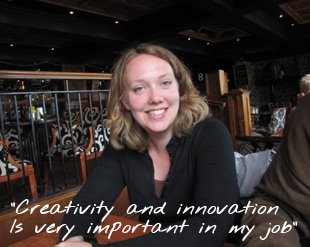
I hold a PhD in chemical engineering and I work with research and development, essentially. So my entire job is taking things from the bare bones and then translating that into something manufacturable in an engineering sense. Creativity and innovation is very important in my job, taking something from a theoretical idea to reality. Say a sensor, I work on sensors right now for the medical industry, taking a scientists concept of a sensor that would work and actually constructing something that we can manufacture efficiently in little time with little cost. You have to use every creative bone in your body to make that work. In a nutshell, my job has to always have that element of discovery and curiously.

That sounds crazy! I would be so stressed out thinking about how you have to take just a concept and change it and invent something totally new. Does that element of stress ever get to you when you’re working?

Well there’s a lot of people and a lot of support so it’s fine. The people are realistic, they all have realistic expectations of what can be done but you know, sometimes upper management expects the impossible. Although, like I was saying before, it’s not just the traditional engineering there’s also “okay I have to market this to upper management and kind of explain why this can’t be done”, so that kind of falls into the other element of relaying to people what can actually be done and what can’t.

Q: What are you doing these days?

I work for a company called Abbott Point of Care and were manufactures of medical diagnostic sensors. Basically you can put a couple of drops of blood in a cartridge and then it tells you on the spot what’s wrong with a patient, so you can do diagnoses in an emergency room very quickly instead of having to send it away to a lab to get analysed. My position is the senior engineer for the company. My job description, I work hand in hand with RMB as well as manufacturing and I’m kind of the middle man. I take the concept of a sensor invention from RMB and make it manufacturable. I went into engineering initially because I wanted to be a brewer, I wanted to brew beer.

Really? And that has to do with engineering?

Oh yeah, that’s totally engineering! So I did internships at Labatt brewery and different places like that and then I ended up going to grad school for bio reactor design, which is fermenters for beers and wine and things like that. That’s what I ended up getting my PhD in. Then I worked for a company doing the same thing, making ethanol. Then about a year ago, two years ago now, I totally made a switch in my carrier path and I went into bio- chemical sensors. So same sort of degrees would apply but totally different research areas and I made a bit of a leap and that was due to pure interest.

You know it’s funny, a lot of the engineers I have been talking to have started out in one field and then half way through say: “You know what? This other thing sounds really interesting”, and then they go and they change fields completely.

Yeah! That’s the power of engineering too, a lot of the skills apply to a wide range of areas. You just have to figure out how to market yourself to say to a company “okay I have these skills and I have this background which could be different but I also can do this job if I apply my skills in a different way”.

Where did you think you were going when you started out?

I didn’t think that far ahead, I’ve got to be honest. I just did something that kind of sounded interesting, sounded cool, I didn’t think about the long term. It was honestly a bit of luck that things ended up the way they did.

Q: Do you feel your work contributes to society? How so?

Well I’m going to say yes because diagnosing patients more rapidly now, right on the bed side basically, means lower health care costs and more lives saved. It’s really neat, very efficient, useful technology.

Q: Why do we need more female engineers?

I think first of all to be even, it should be even and it’s not. Also because females bring a pragmatic sense to engineering and a level headed sort of methodical way to a project that I think is really beneficial.

And in your experience did you notice an overwhelming divide in male versus female enrollment in classes and in your actual workplace and stuff like that?

Not in undergrad I didn’t, when I was doing my undergrad at Guelph, I mean it wasn’t 50/50 but there were a lot of women in engineering. Then when I went to grad school I was one of only a handful that were in graduate school and those grad school positions are the ones that lead to upper management right? You see that in the workplace too, at the intermediate level you get pretty 50/50 with women and men but as you go up the ranks in the senior positions and definitely in executive there are not as many women. Why that is I do not know but there is something wrong with the system when that’s the case.

Yeah I agree. So you said you went to the University of Guelph – Did you like it there? Like I’m still in high school so I was just thinking “what universities are good for science and engineering?” and Guelph was one of the ones that I was looking at.

Oh I loved Guelph. Absolutely! It’s got a really great campus, a really great feel. When I was there the engineering program was small, it was just starting out, and I think it’s a bit bigger now but it’s still on the smaller side. So with that you get really great professors that are really invested, you get a really good community of students. Yeah, I would recommend Guelph. Also I did my grad school at Queens and I liked it because there’s a lot of stuff there. The engineering environment there for an undergrad is a lot more intense then Guelph. If you’re a more laid back person then I think Guelph would be the place for you.

– – – – – – – – – – – – – – – – – – – – – – – – – – – – – – – – – – – – – – – – – – – – – –
Check out Jennifer’s work

Filed Under: Journeys Tagged With: bio-process, chemical, co-op, engineering, environment, Jobs, journey, PhD, university

Shaina Dinsdale

by admin

Shaina Dinsdale

Q&A WITH EngHERO: Shaina Dinsdale

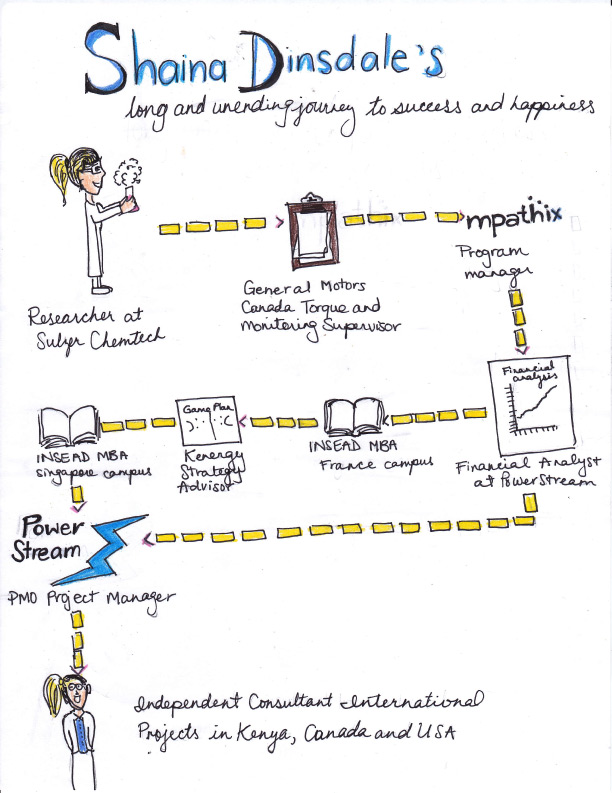
Shaina is an amazing engineer who has traveled the world and is full of wisdom. She has been in many occupations, in diverse regions of the world in search of the perfect occupation to satisfy her happiness, success and her values. Shaina Dinsdale

Q: What’s one thing you wish you knew about engineering back when you were in high school?

I wish I knew what it was all about. I have three older brothers who are all in engineering and I thought it was about building cars and airplanes. When I finally got around to doing it I loved it. The degree didn’t mean that now I’m certified to build a car, in fact and engineering degree could be applied in many different ways. My degree is what has helped me get to where I am today, it helped me build my future.

Q: What’s your proudest accomplishment as an engineer?

Actually, I have two. Oddly enough, graduating was a very proud moment. It took me a long time to understand that I was truly capable of earning the degree. I always had good marks and loved the classes but somehow never believed in myself. Graduating was the proof I needed and things came easily after that. A proud moment working as an engineer is definitely some of my recent work in Kenya. It was great because I was there as a consultant but my degree in chemical engineering was very useful to the team. I got to do both business and engineering and was such a strong contributor because of it.

Q: Tell me about a time in your career when your work has been about discovery or curiosity?

I think it was right when I got out of school. I moved to Switzerland and did research for a Chemical Mixing Company creating a design equation for their sales team. It took me hours of lab work to discover the best way to model what happens when two gasses pass through their static mixers.

Q: What are you doing these days?

I’m currently working as a consultant helping companies manage projects when they don’t have the capacity to do it in house. I would have to say determination and a lot of random events brought me here. I have learned that people you meet early on in your career are very important. You should never burn a bridge because at eventually you will need to cross it. I made many contacts in the first years of my career, which continues to help me today.

When I started out I wanted to move to Europe. I thought I would stay there for 5 years and be an engineer. But life takes to down different paths and now, I have worked in Switzerland, Canada, Kenya, and am currently in New York. Who knows where things will take me next.

Q: Do you feel your work contributes to society? How so?

Yes. As an engineer it always did, I was building things, improving how things worked or were made, was always working on something current. Now that I am more removed from engineering the contribution feels a little less direct.

Q: Why do we need more female engineers?

More female engineers will bring diversity into the engineering field. Diversity is great. It helps make better decisions and women should most certainly be part of those better decisions. We need more women to understand what engineering is about and know that they are capable of it. I think they need to know what a degree could do for them. If women know what it is about then perhaps we will see a change in statistics. Diversity helps make better decisions and women should most certainly be part of those better decisions.

Q: What advice would you give to someone interested in the field of Engineering?

Do your research and go for it! And to women who like chemistry I would urge them to explore chemical engineering. If you like biology, make sure you look at biomedical engineering…etc.

Shaina-Dinsdale-Journey-May

Filed Under: Journeys Tagged With: AMAZING, beautiful, engineer, happiness, innovative, inspiring, success, traveler, values, wise

Erika Kiessner

by admin

Erika Kiessner

Q&A WITH EngHERO: Erika Kiessner

Erika Kiessner is an exhibit developer for an independent exhibit design and fabrication company. She creates all the cool interactive exhibits at places like the ROM or Ontario Science Centre!Erika Keissner Polaroid 2

Q: What’s one thing you wish you knew about engineering back when you were in high school?

I honestly wasn’t sure what I was getting into when I signed up for engineering. I just knew that it was a good place to go if you were good at math and interested in science. I guess I wish someone had told me how abstract it is. An engineering degree isn’t about learning a set of concrete skills. It is more about learning a set of mental tools and approaches for solving problems. Thankfully that toolkit can be useful in a lot of fields. I’m very glad that I did an internship as part of my degree. It showed me the kind of work that I wouldn’t be happy doing long term.

Q: What’s your proudest accomplishment as an engineer?

This question is hard since I don’t work as an engineer. I have done some work doing mechanical and electrical design for artists and I have developed some elegant systems for several art pieces. Ironically the mechanisms were all hidden away inside the pieces so no one but me could really appreciate them!

Q: Tell me about a time in your career when your work has been about discovery or curiosity?

I am very fortunate that most of my career has been about discovery and curiosity. I have done a lot of work for science museums and to properly design an exhibit to explain a concept you really need a deep understanding of that concept. Plus, one of my goals in designing a good exhibit is to get people curious. And to do that I have to be curious myself.

Q: What are you doing these days?

My job now is as an exhibit developer for a small independent exhibit design and fabrication firm called Aesthetec Studio, in Toronto. We do concept development, prototyping and electronics fabrication for exhibits for museums and other institutions. Basically anything interactive that is a hybrid of the digital and physical is in our wheel house. I started at the Ontario Science Centre as floor staff talking about science to visitors.

I knew before I graduated that I wasn’t interested in going into a traditional engineering job and through my undergraduate thesis, I got to know some people at the OSC. So I started on the floor and worked my way into designing exhibits, something I can definitely thank my engineering degree for.

I spent three years there developing new exhibits and that was where my career started. After the OSC I took a year to do a masters degree in Fine Arts, specializing in interaction design. This gave me another set of tools to apply to my practice and helped me look at my work in more than one way.

Q: Do you feel your work contributes to society? How so?

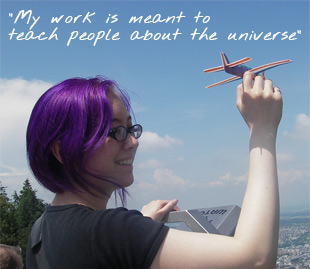
Absolutely. My work is meant to teach people about the universe and more importantly, get them excited about finding out how and why things work.

Q: Why do we need more female engineers?

I think there are two reasons. The first is that in any field that is involved in problem solving, the more perspectives that come to a problem the better scope the proposed solutions will have. The second is that engineering culture would be better served by having more women, for much the same reason.

Q: Why do you personally believe the statistics are the way they are in terms of females in engineering?

Not all of the streams of engineering have an unbalanced female to male ratio. At the University of Toronto, where I studied, chemical engineering was affectionately known as “Fem Eng” because it was predominantly women. Similarly, I would estimate that industrial engineering, the stream I studied was about 40% women. I believe computer engineering was a bit lower but the ones that really stood out were mechanical engineering and electrical engineering, in which there were far more men than women. So what I really wonder is why some types of engineering attract women and others do not.

Generally, I think males get more encouragement to be strong in math and science than women do. That is changing, I hope. I also think that females are more willing to assert themselves in these areas over any societal opposition, than they were a generation ago. The old guard is turning over into the new, and ever more women will get into engineering. At one time doctors were all men and now women are pretty much equally represented. I think engineering will go that way too.

– – – – – – – – – – – – – – – – – – – – – – – – – – – – – – – – – – – – – – – – – – – – – –
Check out Aesthetec Studio‘s work

Filed Under: Journeys Tagged With: education, ENGartist, exhibitdeveloper, Female Engineer, fun, indie, innovative, interactive, Interview, Jobs, Jobs in Engineering, Path to Engineering, unique, Women, Women's in Society

« Previous Page
Next Page »

Footer

Menu

  • About WEMADEIT
    • Donor
    • Partners
      • Toronto Metropolitan University
      • Ontario Tech University
      • University of Waterloo
      • Western University
  • For Students
    • Blog
    • Getting There
      • Engineering Disciplines
      • Student Life
      • Where Can I Study?
      • What You Don’t Know About Engineering
      • ENG BLING
    • Black Students
    • Indigenous Students
    • 2SLGBTQIA+ Students
    • Women and Girls
  • For Parents
    • Where Can You Study Engineering?
    • What is Engineering?
  • For Undergrads
    • Gaining work experience
    • Peer Mentorship
    • One Awards
    • Next Generation in Power
    • New Grad Program
  • For Teachers
    • Teacher Resources
  • Getting Involved
  • Contact Us
    • Newsletter Signup

Search

Teacher Login

Register | Lost your password?

  • Facebook
  • Instagram
  • Twitter

© 2026 · WEMADEIT | Site Design by rtraction