• Skip to primary navigation
  • Skip to content
  • Skip to primary sidebar
  • Skip to footer

We Made a Difference. We Made it Together. WEMADEIT.

  • About WEMADEIT
    • Donor
    • Partners
      • Toronto Metropolitan University
      • Ontario Tech University
      • University of Waterloo
      • Western University
  • For Students
    • Blog
    • Getting There
      • Engineering Disciplines
      • Student Life
      • Where Can I Study?
      • What You Don’t Know About Engineering
      • ENG BLING
    • Black Students
    • Indigenous Students
    • 2SLGBTQIA+ Students
    • Women and Girls
  • For Parents
    • Where Can You Study Engineering?
    • What is Engineering?
  • For Undergrads
    • Gaining work experience
    • Peer Mentorship
    • One Awards
    • Next Generation in Power
    • New Grad Program
  • For Teachers
    • Teacher Resources
  • Getting Involved
  • Contact Us
    • Newsletter Signup

Getting There

Interested in becoming an engineer or ENGBEAUT yourself? First of all, that’s awesome. Second, here is a ton of stuff that will give you an idea about what schools offer engineering programs, eng-university life, and different ways to approach engineering.

Advice For The Next Generation Of Women In STEM

by wemadeit

Advice For The Next Generation Of Women In STEM

As women remain dramatically underrepresented across all STEM studies and careers, how do we make strides to close the gender gap and fuel the next generation of female innovators? At a time when technology continues to transform the way we live, work and learn, the need to close the STEM gender gap is more critical than ever.

With that mission in mind, Forbes partnered with Audi of America in March to host the second annual “Idea Incubator,” a program dedicated to inspiring future STEM leaders by bringing together emerging talent to solve real-world challenges through a STEM lens. Students from the New York University Tandon School of Engineering were tasked with developing innovative solutions around the impact electric vehicles will have on urban mobility. The top two winning teams of students walked away with awards from the “Audi Drive Progress Grant,” a combined $50,000 scholarship toward their studies.

I asked the young women of the first place team to share for their best advice on unlocking opportunities for the next generation of women in STEM. From pushing past fear of the unknown to denying false stereotypes, their insights and lessons learned highlight what to expect for those who want to follow in their footsteps.

Get Comfortable Feeling Uncomfortable

“My advice for women wanting to enter the STEM field would be to not be afraid to get uncomfortable. Often times, you may find opportunities that you think you can’t do, but the truth is that you really can. It’s okay to feel uncomfortable and try things you’ve never done before because you never know, it might turn out that you actually like it. For example, I was never a fan of coding or computer science. I took a coding class in high school and I was completely lost, I didn’t believe that I could really do this as a career. It wasn’t until I got to be a part of programs like Women in Technology, where I got to actually shadow women in the tech industry, and Kode with Klossy, where I got to learn coding and collaborate with other young women interested in coding, that I actually realized that coding isn’t really that bad, and now I am pursuing a computer science! Be comfortable with trying new things, and don’t be afraid to reach out to others!”

Vidya Gopalakrishna, Freshman, Computer Science Major

Push Past Gender Stereotypes

“Choosing to follow a path less traveled by those of your demographic will always be a difficult decision. Even more challenging, however, is sticking to that path as you’re continually faced with the actions and opinions of those who are implicitly biased towards maintaining a particular status quo. My best advice to women aiming to pursue careers in STEM fields is to succeed in the face of this opposition with as much grandeur as possible. Recognize that there exists in some this internal bias but refuse to let it corrode your sense of self-worth and limit what you think yourself capable of. Bring to the table your unique perspective and hard-earned talents and no one can reasonably refuse you a seat.”

Nicole Lyons, Freshman, Chemical and Biomolecular Engineering Major

Network Your Way To Success

“When answering this question last year, I emphasized the importance of busting the math myth; a myth in which excelling in math was a prerequisite to pursuing a career in STEM. While this sentiment still rings true, I want to emphasize the importance of networking. Fostering meaningful relationships for your professional career is necessary to enter and succeed in a STEM field. Networking can be as simple as participating in school clubs, signing up for tech newsletters, or even going to your professor’s office hours.

I was first introduced to STEM when a high school friend asked me if I wanted to join the robotics team he created for our school. Had I not had him in my personal network, I would never have taken STEM seriously as a profession. Amazingly, these small interactions have had a domino effect. I’ve managed to build my network by expressing my passions with professors who have then later recommended me for research positions and even been my reference contacts in my job search. Staying in touch with school administrators has been greatly beneficial.”

Aida Mehović, Senior, Computer and Electrical Engineering Major

Filed Under: #shareABLE, #surveySAYS, engSPIRATIONAL, Getting There

Engineering Video Games

by wemadeit

Engineering Video Games

We live in such a busy world, sometimes it’s hard to take time for ourselves. But, everyone needs downtime and that’s a fact. We need to take time to relieve the stress of everyday and recharge. Some people listen to music, watch movies and even play video games. Video games are a great way to spend your spare time because they can be lots of fun while stimulating your mind. As creatives and academics, it’s a good idea to find new ways to exercise our brains. Here is a list of video games that you have to check out!

1. Space Engineers (PC)

This game’s connection to engineering should be obvious given its name and all. The best part about Space Engineers is that you can still learn more about your interests while escaping from the everyday. Space Engineers gives players an immersive experience in the galaxy, in which you get to get to do things like build spaceships and space stations. Space Engineers is a survival-based game, which is very fast pace making for a competitive and exciting experience. This game is available on Steam for purchase and download. Make sure to check this one out next time your bored in front of your computer screen!

2. Don’t Starve (Multi-platform)

Don’t Starve is another nail-biting survival game, that is perfect for anyone who is in dire need of a wild adventure. In this multi-platform game, you are playing as Wilson, a scientist who finds himself in a dark world full of terrible twists and turns. Your goal is simple: survive and most important don’t starve! Throughout the day you can find food, collect materials and even craft different tools you can use during the night. The night is when various monsters and creatures appear all looking for something to eat. This game is great because it really builds your problem solving and strategy skills, along with the appropriate amount of whimsy.

3. Civilization (Multi-platform)

Civilization (Civ) is great for anyone interested in civil engineering, or anyone who ever wondered what it would be like to a rule an entire civilization. The graphics in this game do not disappoint, giving players a completely beautiful experience. Players pick a civilization to rule and lead their people through history, right into the future. The goal of this game is to have the best civilization possible, this involves making various decisions around things like military, architecture and agriculture. You can win the game in many ways including; diplomacy, exploration and economic growth. Civ is sure to be tons of fun while still teaching you something about how the world works.

4. Spacechem (Multi-platform)

Calling all chemical engineers and enthusiasts alike! Spacechem is a puzzle-based game that tasks players to take raw materials and build them into chemicals. Players take on the role of rector engineer that works for Spacehem, who must build various gadgets. This is sure to keep you engaged, with the different levels of difficulty. Spachem is great for anyone who wants to learn something new and has no problem thinking outside of the box. Your chemistry skills will come in handy but don’t worry, the game is full of helpful tips that will guide you along the way. This game’s difficulty is sure to keep anyone engaged, and will lead to a great deal of celebration upon solving each task.

5. Elite: Dangerous

In need of an escape from the normalities of every day? Well Elite: Dangerous is perfect for you! This game is an open-ended (sandbox like) game that takes players on a journey through space. You can fly anywhere in the galaxy, mine asteroids and upgrade your spaceship. Elite: Dangerous also gives players a detailed map of the milky way galaxy, that they are free to explore and interact with. If you are looking for a more interactive game, Elite: Dangerous has got you covered with the ability to play both single-player and multiplayer. So next time you look up to the stars and crave some intergalactic fun, log onto to Elite: Dangerous.

There you have it, your latest cure to boredom! These games are sure to get you hooked and keep you entertained. Who knew STEM could be this fun? 

Filed Under: #shareABLE, Getting There, Grade 7, Grade 8, Grade 9, Reviews

engHERO: Ada Barlatt

by wemadeit

engHERO: Ada Barlatt

What’s one thing you wish you knew about engineering back when you were in high school?

I wish I knew the breadth of engineering! There are so many opportunities and applications. The numerous branches of engineering means that it is really a foundation for anything. I wish I knew that engineering would teach me how to problem-solve, develop critical thinking skills and prepare myself for any future problems I encounter. If you had told me that engineering was a way of life, I would have been much more excited and confident to pursue this field right away.

What is your proudest accomplishment as an engineer?

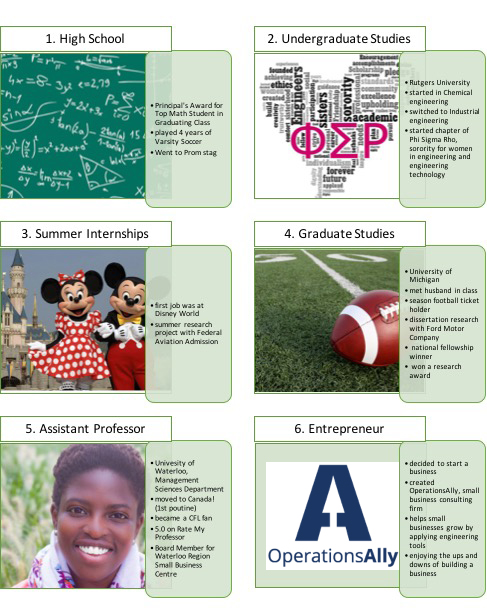
My proudest accomplishment to-date would have to be that I started my own business. I took the tools, techniques, concepts, experiences and technology from my engineering background and applied this as an operations consultant for small businesses. I now focus on making small companies’ lives more efficient and effective. I love that I can see the positive impact on my clients’ lives and businesses!

Tell me about a time in your career when your work has been about discovery or curiosity?

My actually career path has been about self-discovery and being curious about different opportunities. My move to Canada was a very big catalyst for my self-discovery – I decided to try the role of assistant professor. However after a few years, it became clear that I didn’t want to be in academia forever so I kept asking myself questions. What do I want to do? What skills should I explore? What new things do I want to learn? I knew engineering gave me the capacity to improve whatever area I was passionate about so I was open to trying new paths in my career.

What are you doing these days?

My business, OperationsAlly, helps small companies who are ready to grow, but are fully aware that the way they are running their business (e.g., the way that they are operating) won’t support the growth that they want.  Since I have a background in Industrial engineering, I am able to design (and implement) the personalized systems these businesses need to get the growth that they want.  Through my business, I get to play match-maker, curator and designer as I create tailored solutions to address each businesses’ specific needs.

Do you feel your work contributes to society? How so?

Yes I do! By definition, engineering contributes to society. For me, I can really see my impact and contributions both as an entrepreneur and with my previous jobs in larger organizations. My experiences with Walt Disney Parks showed me that I could have a big impact even as one person within a bigger organization. Now my impact is one business at a time. I see the value in both types of roles, but I prefer to have a direct impact on specific people – it feels more personal for me. Either way, engineering has been a great field for improving the aspects of society that I am passionate about!

Why do we need more female engineers?

We need to change the perception of engineering because I actually think that we are missing a lot of females in industry who are doing “engineering activities” without getting this label. I wish more women and girls knew about the breadth of engineering! We really need to focus on finding girls who are passionate about solving problems and harness this. We can do this by highlighting that engineering is a means of contributing to society and to fully explain what it really means to be engineer. It is important that we increase the awareness of females towards engineering so that they can make a conscious choice whether or not to pursue this field. They need to know what they are saying ‘no’ to.

What advice would you give someone interested in the field of engineering?

Talk to lots of people! Start-up conversations with different types of engineers and in different fields. I also recommend asking yourself “What in the world do I want to fix?” because you need passion in your career path. Engineering will help you problem-solve any aspect of society that you want to fix. It will also give you a foundation in hard work, perseverance and dedication. It opens up so many fantastic opportunities!

Image of Ada's journey

Filed Under: engHEROES, engSPIRATIONAL, Getting There

FAQ’s

by admin

So you’ve been reading about engineering and it sounds waaaaay cooler than you originally thought, but you still have a bazillion questions buzzing around in your brain. We’ve asked real girls what THEIR questions about engineering are – read on to find out all the engineering deets you never knew you needed!

Q: What does an engineer’s normal day look like? Some jobs seem all great and dandy but I want to know more specifics about a career I’m considering!

There is no “normal” for engineers – each job is as different as you and I! Your typical day will depend on the type of engineering you major in (i.e. Mechanical, Aerospace, Civil), as well as the company you apply to work for.

Some engineers work in office buildings, while others work in labs or industrial plants. Others go into sales or management jobs. Some work outdoors or in production and construction sites. Certain jobs also allow engineers to travel all over the world.

This being said, there are some common themes to engineering jobs:

  • They usually run on a 40-hour workweek (workin’ 9 to 5)
  • They often involve lots of teamwork and problem solving
  • Engineers are always working to improve current systems
  • Beginner engineers usually work under the supervision of more experienced engineers – so don’t worry, you’re not immediately expected to know everything!
  • Once you gain more experience and knowledge, you’ll be assigned to more complicated, interesting projects where you’ll work to design, solve problems and make decisions.

Luckily, a degree in engineering leads to a TON of different pathways, meaning that you have lots of opportunities to choose a “day in the life” that fits you.
For more info, check out our interviews with University Students and Professional Engineers

Q: How long does it take to become an engineer?

It takes only four years to graduate from a Bachelor of Applied Science or Engineering degree, which allows you to start doing engineering work right away as an “Engineering Graduate”! After you complete your degree, you apply to work under a licensed professional engineer, usually between 2 – 4 years – this helps you to continue improving your skills while still making a salary. After that, you take a test that allows you to officially call yourself a Professional Engineer for life!

Q: Can I quickly and easily get a job in engineering immediately after graduating university?

You’ve probably heard people talking about the recession and how it’s harder for young people to get jobs nowadays. Luckily, job prospects in engineering are MUCH better than most, particularly if you’re open to moving within Canada!

Q: What is an engineer’s favourite thing is about their job?

To find out what engineers love about their jobs, check out our interviews with Professional Engineers!

Q: How does Co-op work? What companies can I work for and what kind of job I can get after university using the co-op experience?”

A few schools have Co-ops (cooperative education) and Internship programs, including Ryerson, Waterloo, UOIT and Western. During Co-op, your school matches you up with a company that lets you use what you’re learning in school in a real-world situation.

Students often credit co-op with giving them hands-on work experience and allowing them to network with professionals, which can sometimes allow them to find a job more easily after they finish their degree. Remember – even if your school doesn’t offer co-op, you can still apply to be a Summer Intern at many different companies!

Q: Is the engineering business very straight edged or is there room to get creative and innovative when on the job?

Depends on which company you’re working for! The beautiful thing about an engineering degree is that it can lead you down many different paths. If creativity is your strong suit, you can specifically search for a company that is known for its innovation, or you could even become your own boss! While some companies offer jobs that are more “straight-edged,” engineering always involves thinking outside the box and solving problems, which always keep the job interesting.

Q: Is most of your time spent answering and solving formulas and equations or actually building things?”

While there are some technical fields of engineering that involve hands-on building, it’s actually a common misconception that engineers build things. The majority of engineers are thinkers – they use their understanding of math and science to design things before they get built.

Q: What kind of things will I be studying in generally in engineering?

While each stream of engineering focuses on different areas, there are a few skills that you learn in engineering school in any major:

  • Problem solving
  • Sciences (areas of focus depend on your major!)
  • Basic business skills
  • Communication skills (public speaking, resume building, presentation skills etc.)
  • Maths
  • Computer skills
Q: I would like to know what specific duties an engineer has, because I actually don’t really know what an engineer is.

Every engineering job is different, but many have common themes:

  • Researching current systems to figuring out how to make them better
  • Applying science skills to design new solutions
  • Communicating ideas and solutions to others
  • Using computers and technology to help execute your ideas

Job descriptions usually sound SUUUPER overwhelming, but remember: you’ll learn all of these skills (and more!) when you’re in university. If you like problem solving, are creative and are good at math/science, you’ll be a great fit!

For more detailed descriptions of a engineer’s job, check out our interviews with Professional Engineers

Q: How much does the average engineer get paid per month compared to the cost of the schooling to get there?”

Seven out of ten of the top-paid 2013 Bachelor’s degree majors were in engineering (i.e. get money, get paid). In fact, the average starting salary for an engineering graduate is over $60,000! In some areas of engineering, recent graduates make more than $90,000… wild!

Yearly university tuition for an undergraduate engineering student is around $12,000, making your full degree $48,000 – less than one year’s pay as an engineer!

Q: Is engineering a career where you can have fun while working or is it just hard work all the time?

Like most jobs, engineering can be hard work, but most engineers will tell you that they love their job because it’s super interesting! If you want a job that exercises your brain and lets you keep learning, engineering is an amazing option. If you want to know more about how fun jobs in engineering can be, check out our interviews with Professional Engineers.

Filed Under: Getting There Tagged With: engineering, englife, getting there, Universities, university life

The Path to Engineering

by admin

The Path to Engineering

“I think the best way to change a girl’s mind so that she can keep her doors open for a future in STEM, is to show her why. To be able to see the future is power, and if a girl can see what she might be able to become and how she can change, and make a difference for the better (contribute to society) It would really make all the difference. We hear that we should take math and science in the future and not close our doors for better options, but the question is why? Why should I be interested in a future in STEM. To be shown what might happen if I were to pursue something would make me so much more open to the concept of not closing my doors.”

In Canada, there are 40 institutions offering 239 engineering accredited programs. That’s a TON of choice! In university, you can earn your engineering Bachelor’s degree in 4 years.

To get in an engineering program, you’ll need to take math and science all the way through high school:

  1. The following Grade 12 U/M courses. Averages needed to get in will vary by University and programs:
    • English (ENG4U)
    • Calculus and Vectors (MCV4U)
    • Chemistry (SCH4U)
    • Physics (SPH4U)
    • Advanced Functions (MHF4U)
  2. A competitive average (each school will have their own requirements)
  3. Ontario Secondary School Diploma (yep, you need to graduate high school!)

To learn more about what the WEMADEIT Universities offer, check out:             

Filed Under: Getting There Tagged With: getting there, journey, student life

« Previous Page

Primary Sidebar

Categories

  • #shareABLE (70)
  • #surveySAYS (8)
  • engHEROES (50)
  • Engineering Disciplines (35)
  • engSPIRATIONAL (59)
  • Getting There (17)
  • Grade 11 (4)
  • Health (3)
  • Journeys (20)
  • Listen Up (5)
  • listenUp! (2)
  • More2Life (7)
  • Our Favourite Articles (2)
  • Press (3)
  • Recipes (2)
  • Reviews (5)
  • TED talk (17)
  • TheFieldTrip (5)
  • Uncategorized (4)
  • weTHINK (15)

Teacher Login

Register | Lost your password?

Sign Up To Our Newsletter

Footer

Menu

  • About WEMADEIT
    • Donor
    • Partners
      • Toronto Metropolitan University
      • Ontario Tech University
      • University of Waterloo
      • Western University
  • For Students
    • Blog
    • Getting There
      • Engineering Disciplines
      • Student Life
      • Where Can I Study?
      • What You Don’t Know About Engineering
      • ENG BLING
    • Black Students
    • Indigenous Students
    • 2SLGBTQIA+ Students
    • Women and Girls
  • For Parents
    • Where Can You Study Engineering?
    • What is Engineering?
  • For Undergrads
    • Gaining work experience
    • Peer Mentorship
    • One Awards
    • Next Generation in Power
    • New Grad Program
  • For Teachers
    • Teacher Resources
  • Getting Involved
  • Contact Us
    • Newsletter Signup

Search

Teacher Login

Register | Lost your password?

  • Facebook
  • Instagram
  • Twitter

© 2026 · WEMADEIT | Site Design by rtraction