• Skip to primary navigation
  • Skip to content
  • Skip to footer

We Made a Difference. We Made it Together. WEMADEIT.

  • About WEMADEIT
    • Donor
    • Partners
      • Toronto Metropolitan University
      • Ontario Tech University
      • University of Waterloo
      • Western University
  • For Students
    • Blog
    • Getting There
      • Engineering Disciplines
      • Student Life
      • Where Can I Study?
      • What You Don’t Know About Engineering
      • ENG BLING
    • Black Students
    • Indigenous Students
    • 2SLGBTQIA+ Students
    • Women and Girls
  • For Parents
    • Where Can You Study Engineering?
    • What is Engineering?
  • For Undergrads
    • Gaining work experience
    • Peer Mentorship
    • One Awards
    • Next Generation in Power
    • New Grad Program
  • For Teachers
    • Teacher Resources
  • Getting Involved
  • Contact Us
    • Newsletter Signup

engineering

FAQ’s

by admin

So you’ve been reading about engineering and it sounds waaaaay cooler than you originally thought, but you still have a bazillion questions buzzing around in your brain. We’ve asked real girls what THEIR questions about engineering are – read on to find out all the engineering deets you never knew you needed!

Q: What does an engineer’s normal day look like? Some jobs seem all great and dandy but I want to know more specifics about a career I’m considering!

There is no “normal” for engineers – each job is as different as you and I! Your typical day will depend on the type of engineering you major in (i.e. Mechanical, Aerospace, Civil), as well as the company you apply to work for.

Some engineers work in office buildings, while others work in labs or industrial plants. Others go into sales or management jobs. Some work outdoors or in production and construction sites. Certain jobs also allow engineers to travel all over the world.

This being said, there are some common themes to engineering jobs:

  • They usually run on a 40-hour workweek (workin’ 9 to 5)
  • They often involve lots of teamwork and problem solving
  • Engineers are always working to improve current systems
  • Beginner engineers usually work under the supervision of more experienced engineers – so don’t worry, you’re not immediately expected to know everything!
  • Once you gain more experience and knowledge, you’ll be assigned to more complicated, interesting projects where you’ll work to design, solve problems and make decisions.

Luckily, a degree in engineering leads to a TON of different pathways, meaning that you have lots of opportunities to choose a “day in the life” that fits you.
For more info, check out our interviews with University Students and Professional Engineers

Q: How long does it take to become an engineer?

It takes only four years to graduate from a Bachelor of Applied Science or Engineering degree, which allows you to start doing engineering work right away as an “Engineering Graduate”! After you complete your degree, you apply to work under a licensed professional engineer, usually between 2 – 4 years – this helps you to continue improving your skills while still making a salary. After that, you take a test that allows you to officially call yourself a Professional Engineer for life!

Q: Can I quickly and easily get a job in engineering immediately after graduating university?

You’ve probably heard people talking about the recession and how it’s harder for young people to get jobs nowadays. Luckily, job prospects in engineering are MUCH better than most, particularly if you’re open to moving within Canada!

Q: What is an engineer’s favourite thing is about their job?

To find out what engineers love about their jobs, check out our interviews with Professional Engineers!

Q: How does Co-op work? What companies can I work for and what kind of job I can get after university using the co-op experience?”

A few schools have Co-ops (cooperative education) and Internship programs, including Ryerson, Waterloo, UOIT and Western. During Co-op, your school matches you up with a company that lets you use what you’re learning in school in a real-world situation.

Students often credit co-op with giving them hands-on work experience and allowing them to network with professionals, which can sometimes allow them to find a job more easily after they finish their degree. Remember – even if your school doesn’t offer co-op, you can still apply to be a Summer Intern at many different companies!

Q: Is the engineering business very straight edged or is there room to get creative and innovative when on the job?

Depends on which company you’re working for! The beautiful thing about an engineering degree is that it can lead you down many different paths. If creativity is your strong suit, you can specifically search for a company that is known for its innovation, or you could even become your own boss! While some companies offer jobs that are more “straight-edged,” engineering always involves thinking outside the box and solving problems, which always keep the job interesting.

Q: Is most of your time spent answering and solving formulas and equations or actually building things?”

While there are some technical fields of engineering that involve hands-on building, it’s actually a common misconception that engineers build things. The majority of engineers are thinkers – they use their understanding of math and science to design things before they get built.

Q: What kind of things will I be studying in generally in engineering?

While each stream of engineering focuses on different areas, there are a few skills that you learn in engineering school in any major:

  • Problem solving
  • Sciences (areas of focus depend on your major!)
  • Basic business skills
  • Communication skills (public speaking, resume building, presentation skills etc.)
  • Maths
  • Computer skills
Q: I would like to know what specific duties an engineer has, because I actually don’t really know what an engineer is.

Every engineering job is different, but many have common themes:

  • Researching current systems to figuring out how to make them better
  • Applying science skills to design new solutions
  • Communicating ideas and solutions to others
  • Using computers and technology to help execute your ideas

Job descriptions usually sound SUUUPER overwhelming, but remember: you’ll learn all of these skills (and more!) when you’re in university. If you like problem solving, are creative and are good at math/science, you’ll be a great fit!

For more detailed descriptions of a engineer’s job, check out our interviews with Professional Engineers

Q: How much does the average engineer get paid per month compared to the cost of the schooling to get there?”

Seven out of ten of the top-paid 2013 Bachelor’s degree majors were in engineering (i.e. get money, get paid). In fact, the average starting salary for an engineering graduate is over $60,000! In some areas of engineering, recent graduates make more than $90,000… wild!

Yearly university tuition for an undergraduate engineering student is around $12,000, making your full degree $48,000 – less than one year’s pay as an engineer!

Q: Is engineering a career where you can have fun while working or is it just hard work all the time?

Like most jobs, engineering can be hard work, but most engineers will tell you that they love their job because it’s super interesting! If you want a job that exercises your brain and lets you keep learning, engineering is an amazing option. If you want to know more about how fun jobs in engineering can be, check out our interviews with Professional Engineers.


Filed Under: Getting There Tagged With: engineering, englife, getting there, Universities, university life

The Coolest Eng Projects!

by admin

The Coolest Eng Projects!

As members of the WEMADEIT Youth Think Tank we asked and were asked, A LOT of questions. After some reflection, we thought you could stand to hear what we think. Here it is:

“The coolest example of engineering is the International Space Station. It took some serious engineering to be able to construct this ‘out-of-the-world’ product. It has very important purposes that couldn’t have happened without engineers!”

“The coolest example of engineering is the project that Solar Roadways is working on right now! Their plan is to use solar panels to pave the streets of the US and create renewable energy. If all of the pavable surfaces in the US were covered in solar panels it would generate enough power to run the whole country three times over! Check out more here”

“The coolest example/idea of engineering is vertical farming. A project that is still under progress, it is something that is meant to help with the ongoing increase in population (and hence the need for more food and agriculture). At the same time, it takes conservation of natural forests and environment into consideration, going high up instead of growing wide ”

“I think the Pyramids of Giza are the coolest example of engineering because they were made with no modern technology”

“The Rio-Antirrio Bridge in Greece, because no one thought that they’d be able to build a bridge there (because of the depth of the sea, the make-up of the sea bed, the winds and earthquakes, etc.) but through incredible engineering, they managed to make a really strong, successful bridge!”

“The coolest example of engineering are the blueprints they use to plan things with.”

“I think the coolest example of engineering is the Donghai bridge (also known as the Big East Sea Bridge). It is 32.5 km in length and crosses a sea from mainland Shanghai and the offshore Yangshang deep water port in China. There are sections allowing large ships to pass through and it does not allow vehicles on the bridge that do not meet weight requirements. It is one of the longest sea crossing bridges in the world and has previously been titles the longest.”

“The coolest example of engineering is the engineers who invented a charger powered by the sun. It helps with conserving energy, decreasing our green house gas submission and many other everyday problems.”

“The best example of engineering in my opinion is the Falkirk Wheel located in Scotland, which is a boat lift that connects the Union Canal with the Forth and Clyde Canal. It’s one of the coolest civil engineering projects that I’ve seen.”

Filed Under: weTHINK Tagged With: engineering, wethink, youth think tank

Girls Need to Know This About Engineering

by admin

Girls Need to Know This About Engineering

As members of the WEMADEIT Youth Think Tank we asked and were asked, A LOT of questions. After some reflection, we thought you could stand to hear what we think. Here it is:

Our whole lives we’ve been educated about changing the world, this job gives us so many opportunities to make a difference. There is no reason why we can’t do it, engineering is for everyone. We could do great things.

That they can have a massive impact on the world, that anyone can do engineering and physics, it doesn’t take any special talents, you don’t have to be a math genius, all you need is a special interest in making the world a better, more advanced place while challenging yourself (this is what I would want to hear, not necessarily what all girls would care about)

I think girls need to know the options that even looking into engineering can give you. I would tell them about the opportunities they could have if they chose to go into engineering and I would try to give them an engineering role model.

Messages girls my age need to hear is that in this modern day society they are capable of anything they set their mind to. They should not be discouraged because they are females, they should pursue their dreams.

There is so much more to engineering than building bridges! Engineering IS a bridge.

There is so much more to engineering than building a car. Engineers are everywhere in society and most of them are male! Women need to get out there and start working things out to showcasing the brains and beauty we have within our selves.

That engineering is also about creativity and design (not just lots and lots of math and science which seems to perturb and scare some people)

Girls my age need to know that anything is possible. There is no job out there that should be gender dominated. If engineering is their passion then they should follow it. Nothing should restrict anyone from their dreams. They need to be educated on the wide variety of options and everything engineering could provide them with.

If you are willing to put in the work than anything is possible.

Filed Under: weTHINK Tagged With: engineering, future, girlpower, possibilities, we can do it, wethink, youth think tank

Nuclear Engineering

by admin

Nuclear Engineering

What’s this career all about?

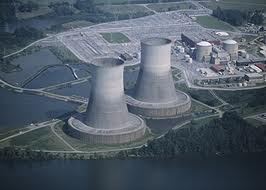
A nuclear engineer researches and develops new applications for nuclear energy and radiation. These new applications include spacecraft, ships, agricultural equipment, and certain medical technology (e.g. the cyclotron, which provides high energy beams to treat cancerous tumours).

What kind of courses do Nuclear Engineers study in school?

  • Principles of Fusion Energy
  • Nuclear Plant Design and Simulation
  • Nuclear Fuel Cycles
  • Nuclear Medicine

What are some cool projects that Nuclear Engineers get to work on?

  • Overseeing construction on nuclear power plants
  • Designing an X-Ray/MRI machine
  • Designing new ways of harnessing nuclear fusion power (a renewable energy source).

What are qualities of a Nuclear Engineer?

  • Resourceful
  • Inquisitive
  • Creative
  • Excellent critical thinking skills

How do Nuclear Engineers contribute to making the world a better place?
Nuclear engineers contribute to making the world a better place in many ways. First of all, they develop new ways of harnessing nuclear power and try to reduce the effects on the environment. This is really helpful to our society. They also work to keep us safe from the potentially harmful effects of radiation. Finally, they develop new technology that can help us, such as diagnostic imaging or cancer-fighting radiation.

Filed Under: Engineering Disciplines Tagged With: engineering, future, Future plans., types of engineering

Jennifer Littlejohns

by admin

Jennifer Littlejohns

Q&A WITH EngHERO: Jennifer Littlejohns

Q: What’s one thing you wish you knew about engineering back when you were in high school?Jennifer-Littlejohns

I guess in high school I probably wish that I knew what options are available for someone with an engineering background in terms of employment. I don’t think people understand the wide range of engineering jobs that can come about with a degree, you know for example you can go into management of people or projects or you could do an actual technical job with calculations or you can go into sales there’s really a wide range of opportunities when it come to an education in engineering. So I think that’s misunderstood, in high school a lot of people think that engineering is always very technical calculations and you’re going to be chained to a desk in an office doing math all day but I think really that is very rarely the case.

Really? Rarely?

Yeah it’s not always that traditional engineering job, now it’s more management that goes into it, more presentations, and relationships with marketing and sales like it’s very unlikely to go into that traditional idea of what engineering is.

Q: What’s your proudest accomplishment as an engineer?

Oh, that’s a tough one! I’m going to have to say I worked for a company called Iogen Corporation and we were attempting to commercialize bio fuels. This unique process to make bio fuels from agricultural waste and my proudest accomplishment was probably when we first started making ethanol efficiently. I remember the first day when we were kind of making a net profit on the on the plants, that’s probably my proudest accomplishment.

It was really great to experience. You know when you work so hard towards something and it actually come true it’s the quintessential biggest benefit of being an engineer it’s when you…

Finally get the eureka moment?

Yeah! It’s so unbelievably satisfying it’s pretty great. Are you going to be an engineer when you grow up?

I’m really looking into it now, being able to talk with all these different types of engineers…it sounds really interesting and there’s a lot of different things you could go into with engineering, there’s so many different options. 

I think there really is. The biggest thing for a high school student I think is I somewhat fell into engineering.

Oh yeah? How so?

I honestly didn’t know what it was about: I knew there was calculations and design and sure, that’s great, I’m a creative person, but you can really get a job out of university. That’s like the biggest benefit; you will find a job straight out of university. With a university education, there are very few streams where that is pretty much guaranteed right, but I’m sure you know that.

Q: Tell me about a time in your career when your work has been about discovery or curiosity?

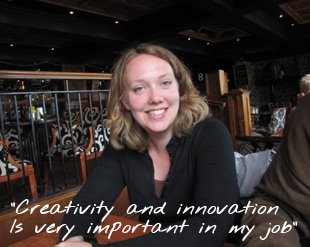
I hold a PhD in chemical engineering and I work with research and development, essentially. So my entire job is taking things from the bare bones and then translating that into something manufacturable in an engineering sense. Creativity and innovation is very important in my job, taking something from a theoretical idea to reality. Say a sensor, I work on sensors right now for the medical industry, taking a scientists concept of a sensor that would work and actually constructing something that we can manufacture efficiently in little time with little cost. You have to use every creative bone in your body to make that work. In a nutshell, my job has to always have that element of discovery and curiously.

That sounds crazy! I would be so stressed out thinking about how you have to take just a concept and change it and invent something totally new. Does that element of stress ever get to you when you’re working?

Well there’s a lot of people and a lot of support so it’s fine. The people are realistic, they all have realistic expectations of what can be done but you know, sometimes upper management expects the impossible. Although, like I was saying before, it’s not just the traditional engineering there’s also “okay I have to market this to upper management and kind of explain why this can’t be done”, so that kind of falls into the other element of relaying to people what can actually be done and what can’t.

Q: What are you doing these days?

I work for a company called Abbott Point of Care and were manufactures of medical diagnostic sensors. Basically you can put a couple of drops of blood in a cartridge and then it tells you on the spot what’s wrong with a patient, so you can do diagnoses in an emergency room very quickly instead of having to send it away to a lab to get analysed. My position is the senior engineer for the company. My job description, I work hand in hand with RMB as well as manufacturing and I’m kind of the middle man. I take the concept of a sensor invention from RMB and make it manufacturable. I went into engineering initially because I wanted to be a brewer, I wanted to brew beer.

Really? And that has to do with engineering?

Oh yeah, that’s totally engineering! So I did internships at Labatt brewery and different places like that and then I ended up going to grad school for bio reactor design, which is fermenters for beers and wine and things like that. That’s what I ended up getting my PhD in. Then I worked for a company doing the same thing, making ethanol. Then about a year ago, two years ago now, I totally made a switch in my carrier path and I went into bio- chemical sensors. So same sort of degrees would apply but totally different research areas and I made a bit of a leap and that was due to pure interest.

You know it’s funny, a lot of the engineers I have been talking to have started out in one field and then half way through say: “You know what? This other thing sounds really interesting”, and then they go and they change fields completely.

Yeah! That’s the power of engineering too, a lot of the skills apply to a wide range of areas. You just have to figure out how to market yourself to say to a company “okay I have these skills and I have this background which could be different but I also can do this job if I apply my skills in a different way”.

Where did you think you were going when you started out?

I didn’t think that far ahead, I’ve got to be honest. I just did something that kind of sounded interesting, sounded cool, I didn’t think about the long term. It was honestly a bit of luck that things ended up the way they did.

Q: Do you feel your work contributes to society? How so?

Well I’m going to say yes because diagnosing patients more rapidly now, right on the bed side basically, means lower health care costs and more lives saved. It’s really neat, very efficient, useful technology.

Q: Why do we need more female engineers?

I think first of all to be even, it should be even and it’s not. Also because females bring a pragmatic sense to engineering and a level headed sort of methodical way to a project that I think is really beneficial.

And in your experience did you notice an overwhelming divide in male versus female enrollment in classes and in your actual workplace and stuff like that?

Not in undergrad I didn’t, when I was doing my undergrad at Guelph, I mean it wasn’t 50/50 but there were a lot of women in engineering. Then when I went to grad school I was one of only a handful that were in graduate school and those grad school positions are the ones that lead to upper management right? You see that in the workplace too, at the intermediate level you get pretty 50/50 with women and men but as you go up the ranks in the senior positions and definitely in executive there are not as many women. Why that is I do not know but there is something wrong with the system when that’s the case.

Yeah I agree. So you said you went to the University of Guelph – Did you like it there? Like I’m still in high school so I was just thinking “what universities are good for science and engineering?” and Guelph was one of the ones that I was looking at.

Oh I loved Guelph. Absolutely! It’s got a really great campus, a really great feel. When I was there the engineering program was small, it was just starting out, and I think it’s a bit bigger now but it’s still on the smaller side. So with that you get really great professors that are really invested, you get a really good community of students. Yeah, I would recommend Guelph. Also I did my grad school at Queens and I liked it because there’s a lot of stuff there. The engineering environment there for an undergrad is a lot more intense then Guelph. If you’re a more laid back person then I think Guelph would be the place for you.

– – – – – – – – – – – – – – – – – – – – – – – – – – – – – – – – – – – – – – – – – – – – – –
Check out Jennifer’s work

Filed Under: Journeys Tagged With: bio-process, chemical, co-op, engineering, environment, Jobs, journey, PhD, university

Isabel Deslauriers

by admin

Isabel Deslauriers

Q&A WITH engHERO: Isabel Deslauriers

Isabel Deslauriers is the national coordinator of Let’s Talk Science which organizes cool science activities for younger kids with the help of volunteers across the nation, with hopes of informing children about careers in science and engineering.Isabel Deslauriers in Italy

Q: What’s one thing you wish you knew about engineering back when you were in high school?

I received a lot of information about engineering from my parents. I think that one thing that is good to know is that in engineering you pick what you want to do; there are many jobs available with the same degree, so you can choose the single thing that is best for you to do as a job.

Q: What’s your proudest accomplishment as an engineer?

I think that my job, as a whole, impacts all the volunteers and kids who are involved with different projects. One of the most satisfying aspects is to able to help others discover engineering and their interests in it.

Q: Tell me about a time in your career when your work has been about discovery or curiosity?

There are two examples that I can think of. One is regarding me and using science to solve problems; I was working on cryptography and trying to discover the best code using different ways, and I really enjoyed the application of these skills and methods. The second one is when working with kids and seeing how they are amazed when discovering how to do something.

Q: What are you doing these days?

I’m a national coordinator of outreach at Let’s Talk Science which is a non-profit organization that plans and does hands-on science activities with kids in order to make them interested in science. In terms of education, I have a bachelor’s degree in electrical engineering. I was always interested in science and I attended a science camp during high school that made me interested in engineering, teaching and research. I also volunteered with Let’s Talk Science, because it brought together my interests.

Q: Do you feel your work contributes to society? How so?

I think that my work is helping to move our society towards making a better world. Especially because I’m part of a non-profit organization, I can really feel good about helping others make the most of their abilities.

Q: Why do we need more female engineers?

I think the question is that why aren’t there naturally more female engineers? I think we should give a chance to any girls to know she can to in engineering. Boys and girls are equally interested in science up to grade 5, and girls tend to be less interested afterwards, which is still unclear why, but it could be caused by stereotypes and their surroundings.

Q: You have done some work related to beekeeping and RC airplanes. Could you tell me about them and what made you interested in them?

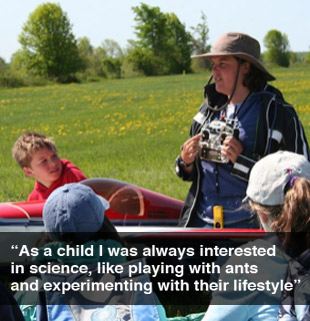
As a child, I was always interested in science, like playing with ants and experimenting with their lifestyle and what influences it. I was also interested in artistic and mechanical things. RC airplanes are one of my hobbies that bring my interests together.

– – – – – – – – – – – – – – – – – – – – – – – – – – – – – – – – – – – – – – – – – – – – – –
Check out Let’s Talk Science

Filed Under: engHEROES Tagged With: better world, children, engineering, Female leaders, future, informative, outreach, volunteering

« Previous Page
Next Page »

Footer

Menu

  • About WEMADEIT
    • Donor
    • Partners
      • Toronto Metropolitan University
      • Ontario Tech University
      • University of Waterloo
      • Western University
  • For Students
    • Blog
    • Getting There
      • Engineering Disciplines
      • Student Life
      • Where Can I Study?
      • What You Don’t Know About Engineering
      • ENG BLING
    • Black Students
    • Indigenous Students
    • 2SLGBTQIA+ Students
    • Women and Girls
  • For Parents
    • Where Can You Study Engineering?
    • What is Engineering?
  • For Undergrads
    • Gaining work experience
    • Peer Mentorship
    • One Awards
    • Next Generation in Power
    • New Grad Program
  • For Teachers
    • Teacher Resources
  • Getting Involved
  • Contact Us
    • Newsletter Signup

Search

Teacher Login

Register | Lost your password?

  • Facebook
  • Instagram
  • Twitter

© 2026 · WEMADEIT | Site Design by rtraction