• Skip to primary navigation
  • Skip to content
  • Skip to primary sidebar
  • Skip to footer

We Made a Difference. We Made it Together. WEMADEIT.

  • About WEMADEIT
    • Donor
    • Partners
      • Toronto Metropolitan University
      • Ontario Tech University
      • University of Waterloo
      • Western University
  • For Students
    • Blog
    • Getting There
      • Engineering Disciplines
      • Student Life
      • Where Can I Study?
      • What You Don’t Know About Engineering
      • ENG BLING
    • Black Students
    • Indigenous Students
    • 2SLGBTQIA+ Students
    • Women and Girls
  • For Parents
    • Where Can You Study Engineering?
    • What is Engineering?
  • For Undergrads
    • Gaining work experience
    • Peer Mentorship
    • One Awards
    • Next Generation in Power
    • New Grad Program
  • For Teachers
    • Teacher Resources
  • Getting Involved
  • Contact Us
    • Newsletter Signup

Journeys

This ain’t no typical all-inclusive week in the Dominican kind of journey. These women have been through a ton of fulfilling and challenging events that have formed their lives and careers. Seriously awesome, check it out.

Four Inspiring Female Inventors

by wemadeit

Four Inspiring Female Inventors

Women have made major contributions to science that have really changed the world, and most of the time they are barely talked about. It is important to highlight the achievements of these women, because they laid the foundation for future scientists! It’s time to add a few more names to your list of idols, because the impact that these inventors had on the world can still be seen today.

1. Shirly Anne Jackson
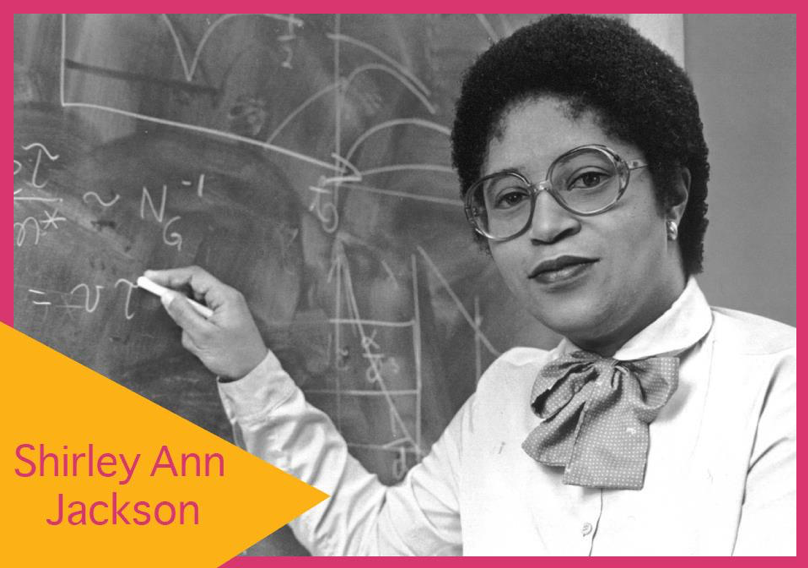
Shirley Ann Jackson is the great mind behind an invention we use everyday, but barely think about. Shirley is an American physicist who invented caller ID. It’s a good thing she did too, that way we know who’s calling us and how to put them on hold. 

That’s not the only thing Shirley Ann Jackson’s research has accomplished, she also had breakthrough studies that lead to inventions such as fibre optic cables and solar cells. Solar energy is increasing in it’s importance because its a renewable energy source. In fact, it is the most abundant energy source on earth, and is cheaper to use than fossil fuels.  

Shirley also made waves being the first African-American woman to earn a PHD from Massachusetts Inusite of Technology. She didn’t stop there she is also the first African-American woman to lead a top-ranked research university. 

2. Hedy Lamarr

Hedy Lamarr was a household name for her time on screen as a movie star, but she is known in the science community as “The Mother of WIFI”. Hedy was born in 1914 and had an interest in how things worked from the age of five. At this age Hedy would take a part her music box to understand how it operated. At the age of 16 her talent for performance was discovered, and from there she started her career as an actress.

The invention that Hedy Lamarr is known for was discovered during the second world war. This device contributed both to the war effort, and helped the entire world advance years afterwards. Her communication system was first created to guide torpedoes to their targets during the war. The system used radio waves, and involved the use of “frequency hopping”. The invention of this technology made an everlasting impact after the war, leading to such inventions such as wifi, bluetooth, GPS etc. 

I mean who can imagine a world without wifi? How would we be able to navigate our lives without Google Maps or Uber?

3. Stephanie Kwolek
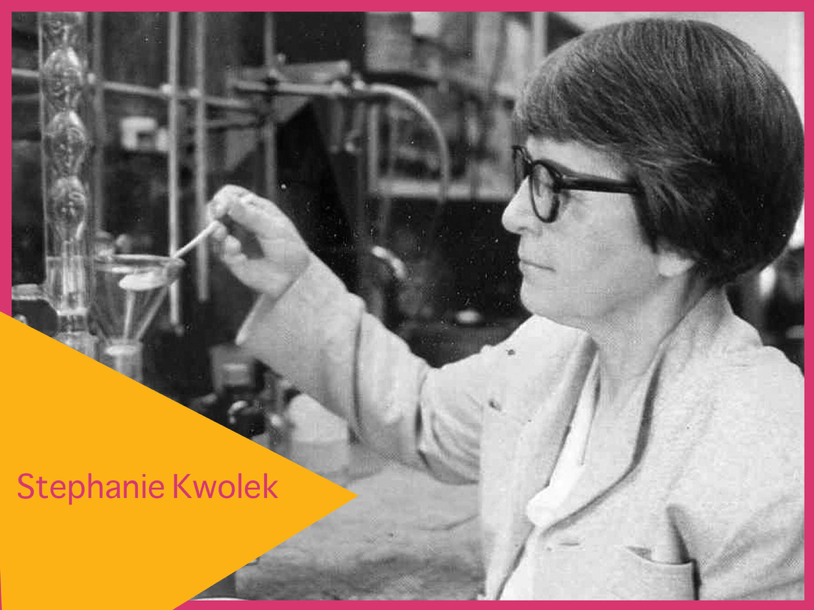
Stephanie Kwolek’s hard work and research saved several lives. Stephanie was born in 1923 and she went to Carnegie Mellon University. She then spent most of her professional career working at the Dupont Company as a chemist. 

There she was asked to research new forms of cable fibres that could survive harsh weather conditions. This task lead to the discovery of Kevlar, which is a strong heat resistant fibre. Now you may be asking what is that? Why does it even matter?

Well Kevlar has many applications including being the fibre in bullet proof vests that have saved countless lives. This is just another example of the impact careers in STEM have on the world, and the importance of always being curious and pushing the boundaries.

4. Grace Hopper
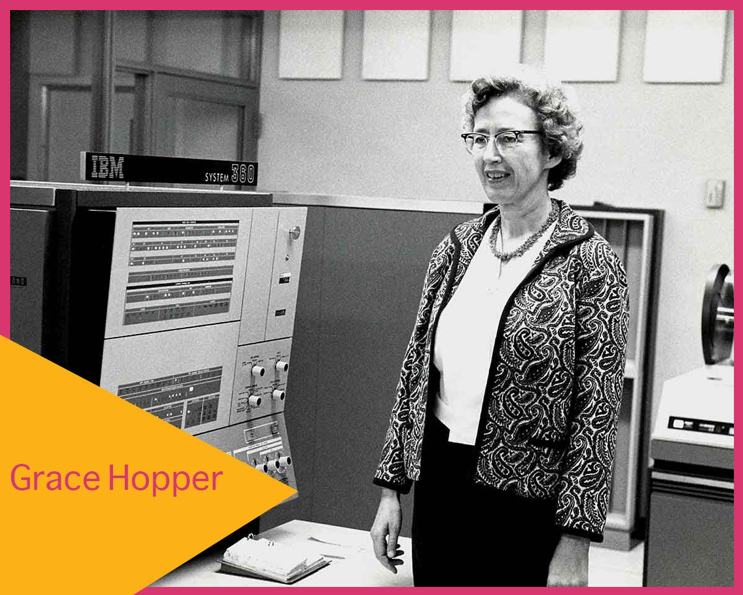
Grace Hopper made serious moves and invitations on a technology you are mostly likely using to read this article. That’s right Grace Hopper was assigned to work on computer technology during the second world war. Then in the 1950s she was one of the leading minds and contributors in computer programming. 

The Compiler was Grace Hopper’s major contribution to technology at the time. Esentiality this device could translate instructions into code that computers can read. This was revoltanrty and lead to faster programming, and ultimately forever changing how computers work.

Grace is known as being one of the most hard working women in the industry, because she continued to work as a computer programmer in the navy until she retired at the age of 79. This making her the oldest serving officer. No wonder she was known as “Amazing Grace” because her contributions to technology have lead to many later innovations with computers.  

These women are perfect examples of all that you can accomplish with a career in STEM, but this doesn’t even scratch the surface. There are tons of other amazing female role models in the industry. Keep innovating, creating and stay curious. Who knows maybe your next discovery will change the world as we know it.


Filed Under: #shareABLE, engSPIRATIONAL, Journeys

6 Exam Studying Tips From 6 University Engineering Students

by wemadeit

6 Exam Studying Tips From 6 University Engineering  Students

Perfect your time management skills so you study effectively, make time for self-care and spend time with your friends and family.”

Sheila (4th-year Industrial Engineering)

Take breaks and study in groups so that you don’t completely isolate yourself.”

Jeffrey (3rd-year aerospace engineering)

Everyone learns differently, so try different ways of studying and find what’s most effective for you.”

Colin (3rd-year mechanical engineering)

Do work as you go instead of doing it all last minute.”

Carol (1st year biomedical engineering)

Make a studying schedule and rest well.”

Sophia (3rd-year aerospace engineering)

Study for a set amount of time without any distractions, and then take that same amount of time off, separating yourself from your work during that time so you can come back strong.”

Div (4th-year aerospace engineering)

Filed Under: #shareABLE, engSPIRATIONAL, Journeys Tagged With: engineering, exams, study, tips, wemadeit

Go ENG Girl- Building Confidence in Young Female Engineers

by wemadeit

Go ENG Girl- Building Confidence in Young Female Engineers

Decisions, Decisions.

If you think back to your days in high school, having to figure out your future in your last year can be daunting. Even if you’re somewhat sure of what you want to study, how do you know for sure? How do you go forward feeling confident and ready to take on new challenges? Many females who are attracted to engineering often relate their interest to early maker projects where they had the chance to take-apart and build new creations, and solve creative problems. Many also find support and guidance along the way from a parent or close family member who also has a vested interest or background in engineering.

However, not everyone has access to these opportunities, so solidifying their decision and confidence to pursue an interest in engineering can be challenging. It’s been noted that girls are often more likely than boys to think that engineering is too difficult, and lack confidence in their ability to succeed and persevere- especially so if that support system is non-existent. This is where events like Go ENG Girl come into play.

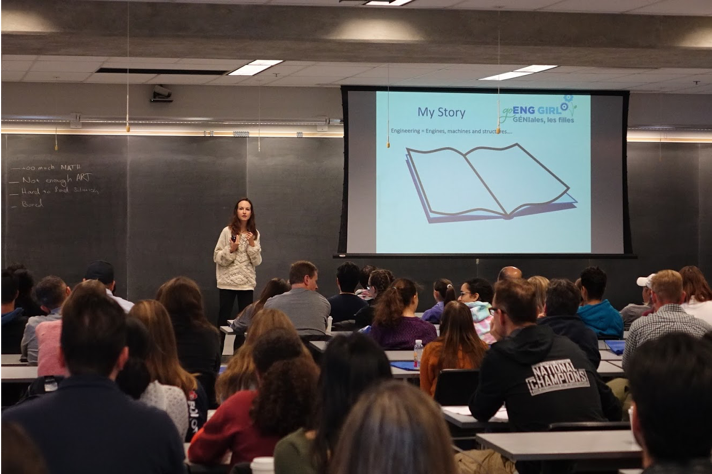
Keynote speaker Katelyn Poyntz, Manager Project Engineering at St. Michaels Hospital.

The Wonderful World of Engineering

Each year, the University of Waterloo’s Engineering Outreach Department runs an event entitled Go Eng Girl, where over 100 Grade 7-10 girls are engaged in learning all about the wonderful world of engineering and its possibilities. Engineering Outreach’s Women in Engineering branch is lead on the event and passionately believes that every girl should have the opportunity to explore her passion, interest, and options in engineering. Through the event, participants are exposed to a network of peers, families, and role models that help answer questions and demystify concerns and stereotypes.

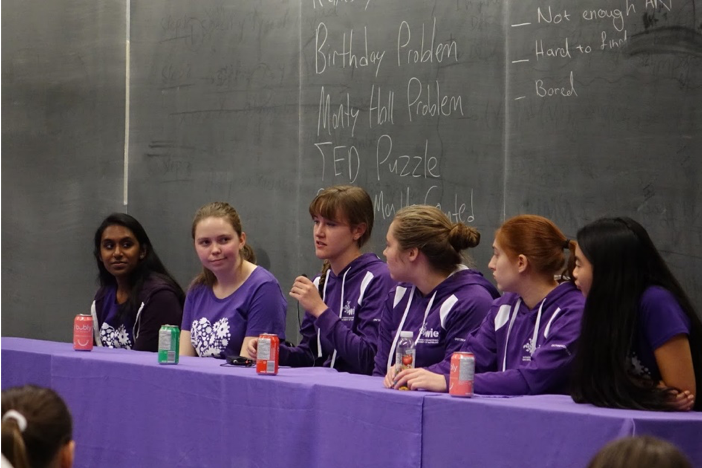
Panelists and role models answer questions.

From keynote speaker Katelyn Poyntz, Manager Project Engineering at St. Michaels Hospital, who shared her journey through the world of engineering, to a panel of current female engineering students, the event provided participants with a network of role models and an opportunity to ask questions and get inspired. The panelists highlighted their experiences, their successes, struggles, hobbies, and inspirations. It was a great opportunity to show these young girls that the panelists are just like them.

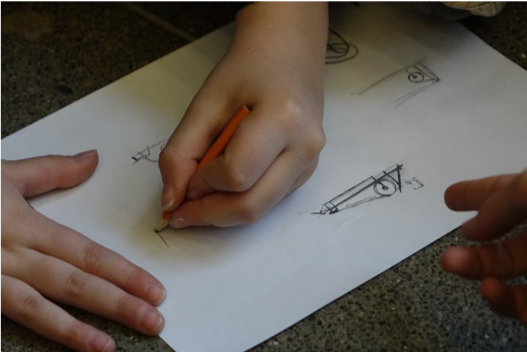
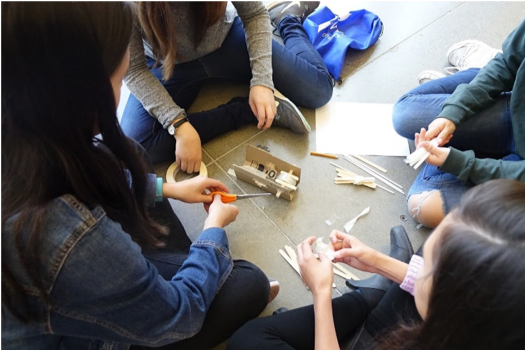
After the panel, participants were engaged in a design challenge which gave them a small glimpse into what engineering is all about. The girls were split up into small teams where they learned about the engineering design process and worked together to solve a problem. Ultimately, the design challenge was a way to empower these young women to experiment, create, and learn the importance of teamwork, failing and perseverance.
While it’s unrealistic to expect that every girl will become an engineer, it is important to show them possibilities they never imagined and help them build the network and support system needed to pursue their passion and get that iron ring.

Filed Under: engSPIRATIONAL, Journeys Tagged With: engineering, events, go eng girl, ONWIE, STEM, Women

WESTERN ENGINEERING – ENGSQUAD

by wemadeit

WESTERN ENGINEERING –  ENGSQUAD
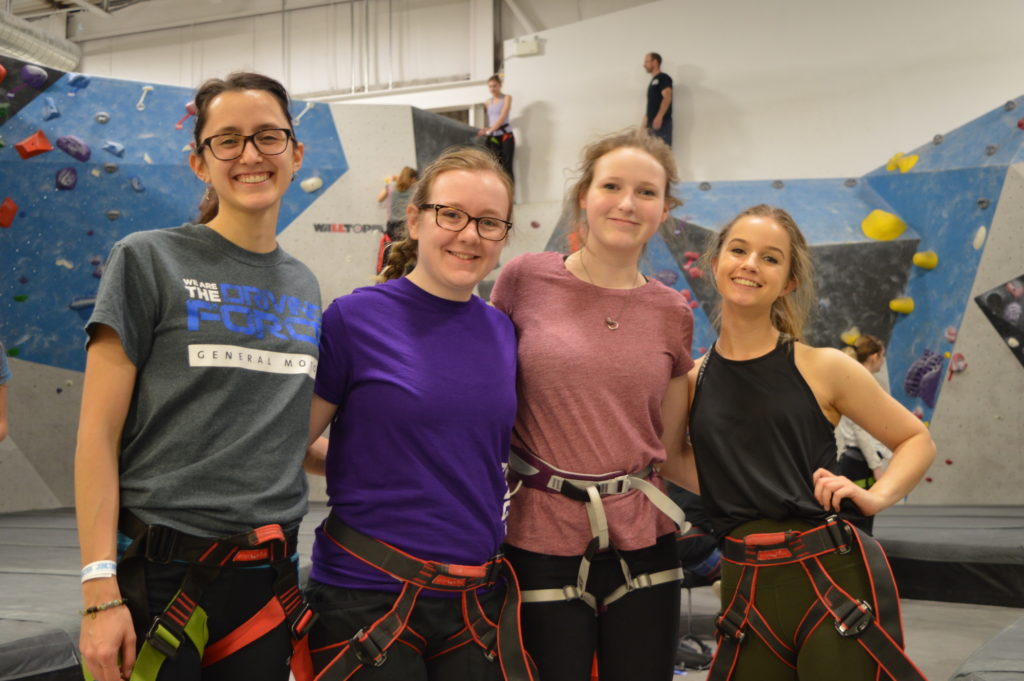
Mentors and High school girls pose for a photo during a outing to a rock climbing gym.

Finishing high school and trying to figure out what you want to do with your future can be a scary task.

It may be that you already know what you want to do so the decision is easy, maybe you have a parent who is an engineer and inspires you, or maybe you have had some exposure to a STEM field and found the combination of creativity and innovation in engineering was right for you.

However, for many young women this isn’t always the case. That is why universities around Ontario create programs and events to give young women the opportunity to explore the wonderful world of engineering.

Western Engineering’s “ENGSquad” is one such program. ENGSquad matches female high school students in Grades 9-12 with mentors who are female undergraduate engineering students at Western University.

Over the course of a weekend girls will get to take part in engineering activities to explore how to achieve creative solutions, visit engineering workplaces to see what can be achieved with a career in engineering, and even have a taste of what it is like to attend a university when they stay overnight in a residence.

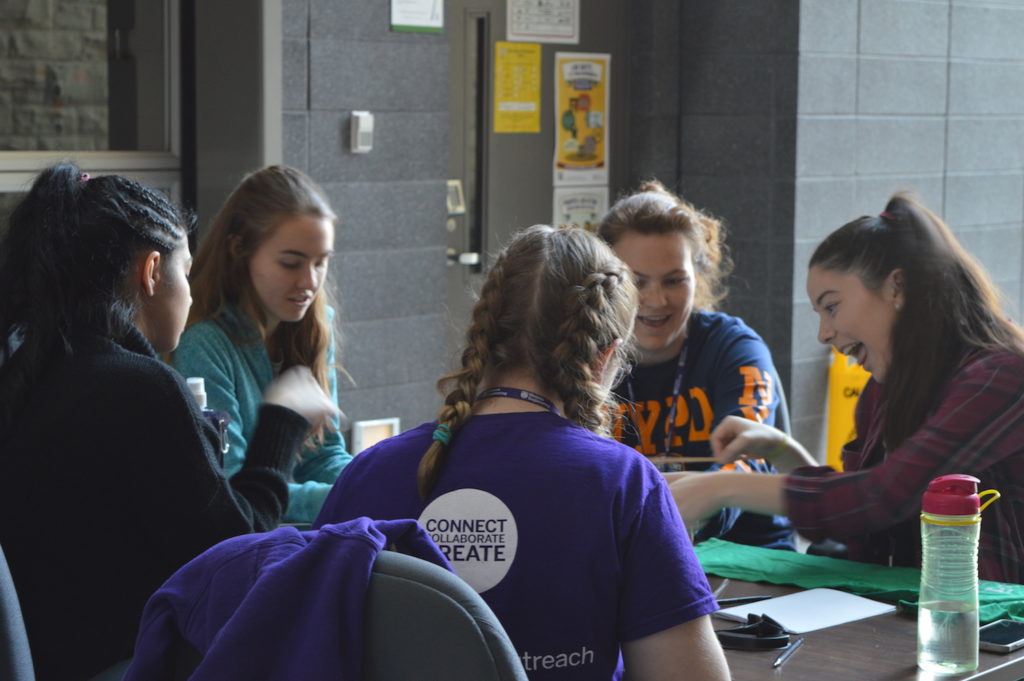
High school girls work in teams to come up creative solutions to a given challenge.

Both engineering and university can be daunting experiences, but that is why Universities across Ontario are working together to ensure that neither obstacle is too high to overcome.

For more about the ENGSquad mentorship program, visit Western Engineering’s website.

Filed Under: engSPIRATIONAL, Journeys Tagged With: engspirational, Female Engineer, STEM, STEM event, wemadeit

Jennifer Littlejohns

by admin

Jennifer Littlejohns

Q&A WITH EngHERO: Jennifer Littlejohns

Q: What’s one thing you wish you knew about engineering back when you were in high school?Jennifer-Littlejohns

I guess in high school I probably wish that I knew what options are available for someone with an engineering background in terms of employment. I don’t think people understand the wide range of engineering jobs that can come about with a degree, you know for example you can go into management of people or projects or you could do an actual technical job with calculations or you can go into sales there’s really a wide range of opportunities when it come to an education in engineering. So I think that’s misunderstood, in high school a lot of people think that engineering is always very technical calculations and you’re going to be chained to a desk in an office doing math all day but I think really that is very rarely the case.

Really? Rarely?

Yeah it’s not always that traditional engineering job, now it’s more management that goes into it, more presentations, and relationships with marketing and sales like it’s very unlikely to go into that traditional idea of what engineering is.

Q: What’s your proudest accomplishment as an engineer?

Oh, that’s a tough one! I’m going to have to say I worked for a company called Iogen Corporation and we were attempting to commercialize bio fuels. This unique process to make bio fuels from agricultural waste and my proudest accomplishment was probably when we first started making ethanol efficiently. I remember the first day when we were kind of making a net profit on the on the plants, that’s probably my proudest accomplishment.

It was really great to experience. You know when you work so hard towards something and it actually come true it’s the quintessential biggest benefit of being an engineer it’s when you…

Finally get the eureka moment?

Yeah! It’s so unbelievably satisfying it’s pretty great. Are you going to be an engineer when you grow up?

I’m really looking into it now, being able to talk with all these different types of engineers…it sounds really interesting and there’s a lot of different things you could go into with engineering, there’s so many different options. 

I think there really is. The biggest thing for a high school student I think is I somewhat fell into engineering.

Oh yeah? How so?

I honestly didn’t know what it was about: I knew there was calculations and design and sure, that’s great, I’m a creative person, but you can really get a job out of university. That’s like the biggest benefit; you will find a job straight out of university. With a university education, there are very few streams where that is pretty much guaranteed right, but I’m sure you know that.

Q: Tell me about a time in your career when your work has been about discovery or curiosity?

I hold a PhD in chemical engineering and I work with research and development, essentially. So my entire job is taking things from the bare bones and then translating that into something manufacturable in an engineering sense. Creativity and innovation is very important in my job, taking something from a theoretical idea to reality. Say a sensor, I work on sensors right now for the medical industry, taking a scientists concept of a sensor that would work and actually constructing something that we can manufacture efficiently in little time with little cost. You have to use every creative bone in your body to make that work. In a nutshell, my job has to always have that element of discovery and curiously.

That sounds crazy! I would be so stressed out thinking about how you have to take just a concept and change it and invent something totally new. Does that element of stress ever get to you when you’re working?

Well there’s a lot of people and a lot of support so it’s fine. The people are realistic, they all have realistic expectations of what can be done but you know, sometimes upper management expects the impossible. Although, like I was saying before, it’s not just the traditional engineering there’s also “okay I have to market this to upper management and kind of explain why this can’t be done”, so that kind of falls into the other element of relaying to people what can actually be done and what can’t.

Q: What are you doing these days?

I work for a company called Abbott Point of Care and were manufactures of medical diagnostic sensors. Basically you can put a couple of drops of blood in a cartridge and then it tells you on the spot what’s wrong with a patient, so you can do diagnoses in an emergency room very quickly instead of having to send it away to a lab to get analysed. My position is the senior engineer for the company. My job description, I work hand in hand with RMB as well as manufacturing and I’m kind of the middle man. I take the concept of a sensor invention from RMB and make it manufacturable. I went into engineering initially because I wanted to be a brewer, I wanted to brew beer.

Really? And that has to do with engineering?

Oh yeah, that’s totally engineering! So I did internships at Labatt brewery and different places like that and then I ended up going to grad school for bio reactor design, which is fermenters for beers and wine and things like that. That’s what I ended up getting my PhD in. Then I worked for a company doing the same thing, making ethanol. Then about a year ago, two years ago now, I totally made a switch in my carrier path and I went into bio- chemical sensors. So same sort of degrees would apply but totally different research areas and I made a bit of a leap and that was due to pure interest.

You know it’s funny, a lot of the engineers I have been talking to have started out in one field and then half way through say: “You know what? This other thing sounds really interesting”, and then they go and they change fields completely.

Yeah! That’s the power of engineering too, a lot of the skills apply to a wide range of areas. You just have to figure out how to market yourself to say to a company “okay I have these skills and I have this background which could be different but I also can do this job if I apply my skills in a different way”.

Where did you think you were going when you started out?

I didn’t think that far ahead, I’ve got to be honest. I just did something that kind of sounded interesting, sounded cool, I didn’t think about the long term. It was honestly a bit of luck that things ended up the way they did.

Q: Do you feel your work contributes to society? How so?

Well I’m going to say yes because diagnosing patients more rapidly now, right on the bed side basically, means lower health care costs and more lives saved. It’s really neat, very efficient, useful technology.

Q: Why do we need more female engineers?

I think first of all to be even, it should be even and it’s not. Also because females bring a pragmatic sense to engineering and a level headed sort of methodical way to a project that I think is really beneficial.

And in your experience did you notice an overwhelming divide in male versus female enrollment in classes and in your actual workplace and stuff like that?

Not in undergrad I didn’t, when I was doing my undergrad at Guelph, I mean it wasn’t 50/50 but there were a lot of women in engineering. Then when I went to grad school I was one of only a handful that were in graduate school and those grad school positions are the ones that lead to upper management right? You see that in the workplace too, at the intermediate level you get pretty 50/50 with women and men but as you go up the ranks in the senior positions and definitely in executive there are not as many women. Why that is I do not know but there is something wrong with the system when that’s the case.

Yeah I agree. So you said you went to the University of Guelph – Did you like it there? Like I’m still in high school so I was just thinking “what universities are good for science and engineering?” and Guelph was one of the ones that I was looking at.

Oh I loved Guelph. Absolutely! It’s got a really great campus, a really great feel. When I was there the engineering program was small, it was just starting out, and I think it’s a bit bigger now but it’s still on the smaller side. So with that you get really great professors that are really invested, you get a really good community of students. Yeah, I would recommend Guelph. Also I did my grad school at Queens and I liked it because there’s a lot of stuff there. The engineering environment there for an undergrad is a lot more intense then Guelph. If you’re a more laid back person then I think Guelph would be the place for you.

– – – – – – – – – – – – – – – – – – – – – – – – – – – – – – – – – – – – – – – – – – – – – –
Check out Jennifer’s work

Filed Under: Journeys Tagged With: bio-process, chemical, co-op, engineering, environment, Jobs, journey, PhD, university

Shaina Dinsdale

by admin

Shaina Dinsdale

Q&A WITH EngHERO: Shaina Dinsdale

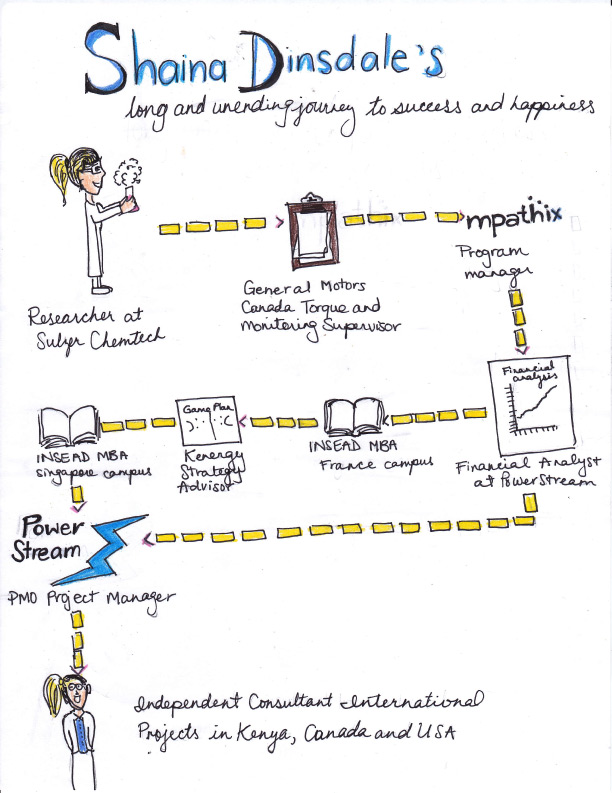
Shaina is an amazing engineer who has traveled the world and is full of wisdom. She has been in many occupations, in diverse regions of the world in search of the perfect occupation to satisfy her happiness, success and her values. Shaina Dinsdale

Q: What’s one thing you wish you knew about engineering back when you were in high school?

I wish I knew what it was all about. I have three older brothers who are all in engineering and I thought it was about building cars and airplanes. When I finally got around to doing it I loved it. The degree didn’t mean that now I’m certified to build a car, in fact and engineering degree could be applied in many different ways. My degree is what has helped me get to where I am today, it helped me build my future.

Q: What’s your proudest accomplishment as an engineer?

Actually, I have two. Oddly enough, graduating was a very proud moment. It took me a long time to understand that I was truly capable of earning the degree. I always had good marks and loved the classes but somehow never believed in myself. Graduating was the proof I needed and things came easily after that. A proud moment working as an engineer is definitely some of my recent work in Kenya. It was great because I was there as a consultant but my degree in chemical engineering was very useful to the team. I got to do both business and engineering and was such a strong contributor because of it.

Q: Tell me about a time in your career when your work has been about discovery or curiosity?

I think it was right when I got out of school. I moved to Switzerland and did research for a Chemical Mixing Company creating a design equation for their sales team. It took me hours of lab work to discover the best way to model what happens when two gasses pass through their static mixers.

Q: What are you doing these days?

I’m currently working as a consultant helping companies manage projects when they don’t have the capacity to do it in house. I would have to say determination and a lot of random events brought me here. I have learned that people you meet early on in your career are very important. You should never burn a bridge because at eventually you will need to cross it. I made many contacts in the first years of my career, which continues to help me today.

When I started out I wanted to move to Europe. I thought I would stay there for 5 years and be an engineer. But life takes to down different paths and now, I have worked in Switzerland, Canada, Kenya, and am currently in New York. Who knows where things will take me next.

Q: Do you feel your work contributes to society? How so?

Yes. As an engineer it always did, I was building things, improving how things worked or were made, was always working on something current. Now that I am more removed from engineering the contribution feels a little less direct.

Q: Why do we need more female engineers?

More female engineers will bring diversity into the engineering field. Diversity is great. It helps make better decisions and women should most certainly be part of those better decisions. We need more women to understand what engineering is about and know that they are capable of it. I think they need to know what a degree could do for them. If women know what it is about then perhaps we will see a change in statistics. Diversity helps make better decisions and women should most certainly be part of those better decisions.

Q: What advice would you give to someone interested in the field of Engineering?

Do your research and go for it! And to women who like chemistry I would urge them to explore chemical engineering. If you like biology, make sure you look at biomedical engineering…etc.

Shaina-Dinsdale-Journey-May

Filed Under: Journeys Tagged With: AMAZING, beautiful, engineer, happiness, innovative, inspiring, success, traveler, values, wise

« Previous Page
Next Page »

Primary Sidebar

Categories

  • #shareABLE (70)
  • #surveySAYS (8)
  • engHEROES (50)
  • Engineering Disciplines (35)
  • engSPIRATIONAL (59)
  • Getting There (17)
  • Grade 11 (4)
  • Health (3)
  • Journeys (20)
  • Listen Up (5)
  • listenUp! (2)
  • More2Life (7)
  • Our Favourite Articles (2)
  • Press (3)
  • Recipes (2)
  • Reviews (5)
  • TED talk (17)
  • TheFieldTrip (5)
  • Uncategorized (4)
  • weTHINK (15)

Teacher Login

Register | Lost your password?

Sign Up To Our Newsletter

Footer

Menu

  • About WEMADEIT
    • Donor
    • Partners
      • Toronto Metropolitan University
      • Ontario Tech University
      • University of Waterloo
      • Western University
  • For Students
    • Blog
    • Getting There
      • Engineering Disciplines
      • Student Life
      • Where Can I Study?
      • What You Don’t Know About Engineering
      • ENG BLING
    • Black Students
    • Indigenous Students
    • 2SLGBTQIA+ Students
    • Women and Girls
  • For Parents
    • Where Can You Study Engineering?
    • What is Engineering?
  • For Undergrads
    • Gaining work experience
    • Peer Mentorship
    • One Awards
    • Next Generation in Power
    • New Grad Program
  • For Teachers
    • Teacher Resources
  • Getting Involved
  • Contact Us
    • Newsletter Signup

Search

Teacher Login

Register | Lost your password?

  • Facebook
  • Instagram
  • Twitter

© 2026 · WEMADEIT | Site Design by rtraction