• Skip to primary navigation
  • Skip to content
  • Skip to primary sidebar
  • Skip to footer

We Made a Difference. We Made it Together. WEMADEIT.

  • About WEMADEIT
    • Donor
    • Partners
      • Toronto Metropolitan University
      • Ontario Tech University
      • University of Waterloo
      • Western University
  • For Students
    • Blog
    • Getting There
      • Engineering Disciplines
      • Student Life
      • Where Can I Study?
      • What You Don’t Know About Engineering
      • ENG BLING
    • Black Students
    • Indigenous Students
    • 2SLGBTQIA+ Students
    • Women and Girls
  • For Parents
    • Where Can You Study Engineering?
    • What is Engineering?
  • For Undergrads
    • Gaining work experience
    • Peer Mentorship
    • One Awards
    • Next Generation in Power
    • New Grad Program
  • For Teachers
    • Teacher Resources
  • Getting Involved
  • Contact Us
    • Newsletter Signup

Getting There

Interested in becoming an engineer or ENGBEAUT yourself? First of all, that’s awesome. Second, here is a ton of stuff that will give you an idea about what schools offer engineering programs, eng-university life, and different ways to approach engineering.

Where Can I Study Engineering?

by admin

The following schools offer engineering programs in Ontario:

Carleton, Guelph, Lakehead, Laurentian, McMaster, Ottawa, Queen’s, Toronto Metropolitan University, University of Toronto, Ontario Tech University, University of Waterloo, Western, Windsor, York

The Path to Engineering

“I think the best way to change a girl’s mind so that she can keep her doors open for a future in STEM, is to show her why. To be able to see the future is power, and if a girl can see what she might be able to become and how she can change, and make a difference for the better (contribute to society) It would really make all the difference. We hear that we should take math and science in the future and not close our doors for better options, but the question is why? Why should I be interested in a future in STEM. To be shown what might happen if I were to pursue something would make me so much more open to the concept of not closing my doors.”

In Canada, there are 40 institutions offering 239 engineering accredited programs. That’s a TON of choice! In university, you can earn your engineering Bachelor’s degree in 4 years.

“Tell her that even if she doesn’t see herself going into engineering or a science career, its always better to have taken all the prerequisites because you never know if you’ll change your mind.”

To get in an engineering program, you’ll need to take math and science all the way through high school:

  1. The following Grade 12 U/M courses. Averages needed to get in will vary by University and programs:
    • English (ENG4U)
    • Calculus and Vectors (MCV4U)
    • Chemistry (SCH4U)
    • Physics (SPH4U)
    • Advanced Functions (MHF4U)
  2. A competitive average (each school will have their own requirements)
  3. Ontario Secondary School Diploma (yep, you need to graduate high school!)
Filed Under: Getting There Tagged With: getting there, Universities

Student Life in Engineering

by admin

Student Life in Engineering

Ever wondered what being a university engineering student is like? We interviewed real eng students, getting them to answer all the questions we think you’re dying to know the answers to!

What’s the “can’t miss” Engineering event of the year?

Heather Aitkin, Toronto Metropolitan University: My favourite engineering event is the “Go Eng Girl” event, hosted by the Women in Engineering group. We organize different engineering-related building activities for attendees from grade 6-10… Those kids build the most amazing roller coasters and almost always beat the parent-built roller coasters!

Chandler Button, Western: The annual Western Engineering Competition! There are Participants complete a variety of tasks, including designing a car that goes through a course with hills, grass, mud, and water. It is a 5 hour challenge with a limited amount of supplies (Dollar store items like motors). It’s pretty cool to see what people come up with. Everyone is really creative so the results are unpredictable.

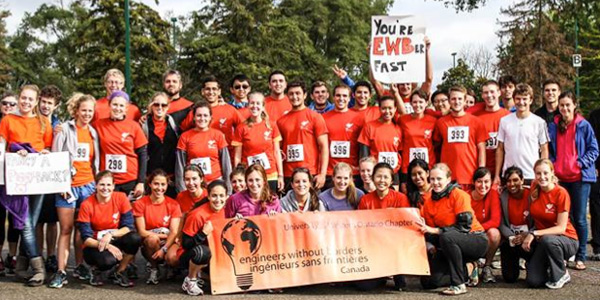
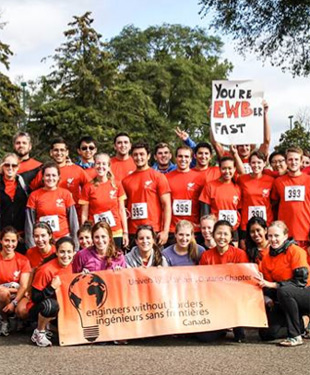
Engineers Without Borders Run

Sharon Flaherty, Western: For me, the “can’t miss” Engineering event of the year would have to be the Engineering Formal, which is held in March. It is the best event of the year where everyone sees everyone!

Dany Awad, Ontario Tech University: ENGSOC’s Annual Reverse Career Fair. It’s basically a career fair where students get to showcase their projects, achievements and professional portfolio to visiting employers. Normally it’s the other way around hence “Reverse”. It’s a great event where you get to speak with a variety of employers and show case your hard work.

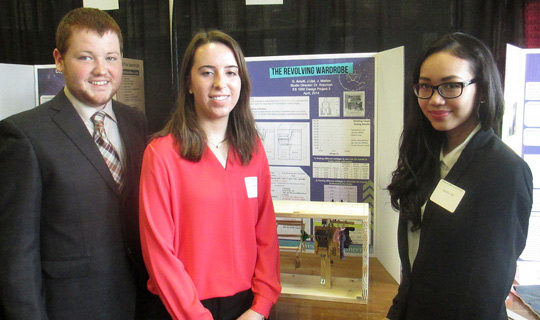
Engineering Student Fair Participants

Sabrina Gomez Vila, Toronto Metropolitan University: We celebrates the National Engineering month in March with numerous events. One of them is the Bug Push, a fundraising event for sick kids foundation that consists of pushing a Volkswagen bug around the Quad in our campus for 24 Hrs.

Jordan Hill, Toronto Metropolitan University: There are also a lot of pub nights – engineering students generally don’t need an excuse to have a good time.  If you like to get dressed up, we has an event in April called the “Billy Ball” where the dress code is semi-formal and there is dancing, a meal, and an open bar.

How was frosh week?

Engineering Frosh Week
Lucy Davidson, Toronto Metropolitan University: Frosh week is an amazing way to get to know your fellow classmates who you will work with for the next four years. We hold an exiting and jam-packed frosh week that makes you feel part of the community as soon as you step on campus the first day. Engineering has some cool traditions as well. Purpling happens during frosh week as well as lots of other fun actives all over the city. I made some really good friends during frosh week and I’m still very close with them now.

Elizabeth Morrow, Waterloo: Frosh week was the best! It really makes you feel like a part of something crazy and awesome. During frosh week I met some of my best friends, and also my boyfriend. My frosh leaders ended up being an amazing resource for me throughout the year and some of my closest friends, helping me with preparing for co-op and dealing with engineering life.

Eng Purple in Front of CN tower

Tell us about your extra-curricular activities… Why are you a part of it?

Lucy, Toronto Metropolitan University: I love being apart of the Women In Engineering society as I am really passionate about promoting engineering to younger women and showing them what it’s really like and how much fun it is.

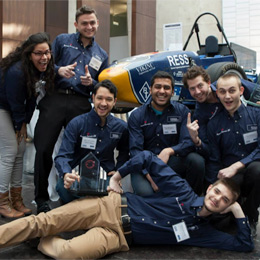
Engineering Formula 1 TeamElizabeth, Waterloo: During my first term, I joined Formula SAE. It was a lot of fun, for a few hours a week we learned 3D modeling and machining, real skills that I could use to get a coop job. I’m also in change of organizing fun events for all the engineers in my year through the Engineering Society.
Carmen Che, Waterloo: Dragon boating… it’s a fun, dynamic community that helps me meet people from across all grades. Finding my place in this community was truly an unforgettable experience.

Chandler, Western: I’m a part of BIG SISTER LITTLE SISTER; this is when first year women get paired with an upper student to make a connection. Your ‘big sister’ helps you with classes and the transition from high school to university… sometimes you even eat lunch with them. In my first year, I was in BIG SISTER LITTLE SISTER. My “big sister” was like my real sister and a good friend. She kept me in the loop and made first year better. Then I wanted to get more involved and become a “big sister” myself, so I decided to run for positions on executive.

Dany, Ontario Tech University: I’m the founder and president of the Ontario Society of Professional Engineers, UOIT Chapter. It all started when I realized that there is more to the actual profession than what we learn in class. Math, science and design are all necessary tools in order to become an engineer but team work, communication skills and time management are just as valuable and you get to learn many of those skills by being involved on campus.

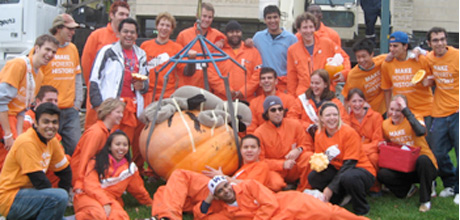
A gang of orange engineers
Natasha Phidd, Waterloo: I’m a big reader and often read mystery novels to relax and give myself a break from my studies. I’m also really into dance, so I like to that as well to relax. Also you can’t ignore some good retail therapy, my friends joke that I have a shopping addiction, but the truth is that I just really enjoy fashion. Everyone can always tell when I’m walking around in the engineering buildings because I’m one of very few that actually wears heels and makeup, but it’s just who I am and my major doesn’t have to change that.

What’s the best thing about being an engineering student?

Stephanie Irving, Ontario Tech University: The best thing about being in engineering is that you make friends for life. We go through so much together in 4 years that the bonds we make are almost unbreakable.

Lucy Davidson, Toronto Metropolitan University: To be a successful engineering student you have to be dedicated and that’s something that’s recognized by people. Studying engineering is extremely rewarding.

Taylor Stanbury, Western: Engineering covers a wide range of topics, so what you’re really learning is how to be a good problem solver, and you can apply that to anything throughout the rest of your life. It may seem intimidating – it is a lot of hard work – but if you put the effort in, it’s worth it.

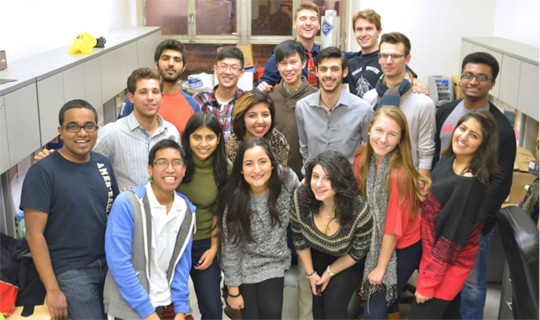
Gang of Engineering Friends
Jordan Hill, Toronto Metropolitan University: The best thing about being an engineering student is how much cool stuff you learn.  First year can be a bit of a drag because you’re really learning the basics that will allow you to learn all the cool stuff. But when you get into third and fourth year and realize that you can design something yourself, it makes you feel very proud of yourself.

What’s a typical day in your life look like?

Heather Aitkin, Toronto Metropolitan University: A typical day in the life involves attending class from 8AM to between noon and 6pm, depending on the day. After classes and labs have finished, I either work on group projects or go to the library to study for the evening. The majority of the semester has involved long working days, but I make sure to see to my friends and take some time for myself as well. I try to never work after classes finish on Friday. Taking Friday afternoon/evening off every week has been an excellent way to see friends from outside of school and relax a bit. It’s good to recharge mentally and do something other than homework.

Elizabeth Morrow, Waterloo: Last school term I would wake up around 8, get to class for 8:30 for 3 hours of lectures until lunch. The top floor of EIT has a little cafe with grilled cheese sandwiches that a few people from my class would get lunch and finish off our assignments due that afternoon. My afternoon consisted of labs and tutorials. After class I would get something to eat, do some work, and then head over to the student shop for a few hours. After that, I might go get ice cream with some friends and catch up with how their programs are going.

Stephanie Irving, Ontario Tech University: A typical day in my life usually involves waking up late, around 11 or 12, then going to class. If I have more than one class that day, I’ll typically stay at school to try and get some work done. After I come home, I’ll make dinner, finish any work I didn’t do and then watch TV. My day usually lasts until 2 to 4am. (Others prefer to get up earlier and go to bed earlier, I like to be a night owl)

What should all high school students know about engineering school? Looking back, what do you wish you knew?

Heather Aitkin, Toronto Metropolitan University: Thinking back to why I didn’t like any of my classes in High School, I think it was largely because I didn’t see how any of it was applicable to what I would end up doing. I now realize that I missed an opportunity to recognize my strengths in design and creative thinking, and I missed the opportunity to see how much I enjoy calculating out answers to problems that I understand. Engineering is SO APPLICABLE to everyday things, but I had never thought of it that way when I was in High School.

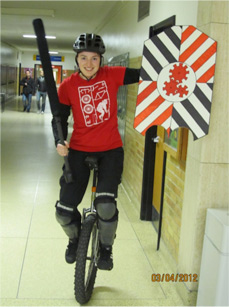
Engineering student on a unicycleTim Carroll, Toronto Metropolitan University: I wish I knew that engineering is basically a program devoted to leaning how to problem solve, independently use critical thinking and being able to communicate your ideas.

Elizabeth Morrow, Waterloo: High school students should know that engineering is hard but not impossible. Don’t be scared off. Also the rumors about having no social life aren’t true at all. I’ve met some of my best friends in engineering, and being stressed out sometimes during the week results in some pretty funny adventures on the weekends.

Sharon Flaherty, Western: All high school students should know that if you’re interested and passionate about engineering, it’s very doable. The community is very inviting.

Jordan Hill, Toronto Metropolitan University: Creativity is far more important than a high IQ. Yes, being very intelligent is useful when it comes to acing that calculus test – but after second year, a lot of your courses will have a design project component which requires a little more independent, thinking-outside-the-box and a lot less number crunching.

Maxine McCurdy, Toronto Metropolitan University: That it’s an option! There are so many engineering jobs out there that this degree can really lead you anywhere. Engineering didn’t even cross my mind in high school. It was not the direction I was headed when I finished school. Never was suggested, or thought of at all. I also wish I had known that taking grade 11/12 Science classes are important in keeping your options open!

How is being an engineering student different from any other student experience?

Sabrina Gomez Vila, Toronto Metropolitan University: As an engineer, I have the power to use my ingeniousness to create something radically new and revolutionize the world.

Chandler Button, Western: My fellow classmates are friendly and not very competitive. Even though the course load is heavy, having classes with the same people and working with teams makes me feel like I’m never alone

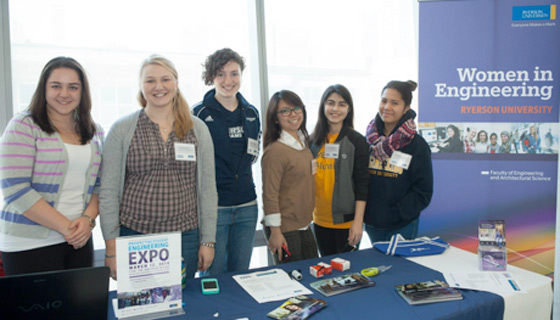
Ryerson Women in Engineering team

Elizabeth Morrow, Waterloo: Being an engineering student is very different from any other program because the community feels so small. Your profs know you by name and check up on how you’re doing, the upper years are your friends and mentors, and every single student’s experience is vastly different because of coop.

Emma Helmers, Western: My friends from other faculties were always super jealous about the closeness I had with my peers. Part of the reason that my classmates and I shared such a good relationship was because we received many projects that were time-consuming and challenging, therefore we had to spend time with each other. I think it breeds a good community, good friendships and good teamwork. Even at work now (I just graduated) there’s the same sense of teamwork, especially in field work as we get it done as a team.

Filed Under: Getting There Tagged With: englife, life, more2life, next level, school, student life, university

Rising Careers in Engineering

by wemadeit

Rising Careers in Engineering

What is the first thing that you think of when you hear the word ‘engineering’? Circuits? Computer softwares? Spaceships? Engineering is such a diverse field of study, you may not know what career to choose. It is important to understand all the different possibilities available to engineering students and which ones will hold the most critical roles in the near future. Here are some of the fastest-growing areas in engineering to help you out.

Biomedical Engineering

Biomedical engineers, or bioengineers, connect engineering principles and design concepts with medicine and biology. As many new medical devices and technologies get introduced to the world of healthcare every day, more and more bioengineers are needed to keep up with the demand. Employment in biomedical engineering saw a 72% growth rate through 2018.

Software Engineering

Software engineering is one of the fastest rising professions in the world! This is because the number of people switching to digital platforms and technologies to do everyday tasks is growing more than ever, especially due to the coronavirus pandemic. Software engineers use computer programming to create software products, internet services, network control systems, and more. The employment of software developers is projected to have the fastest growth of all professions, 22 percent from 2019 to 2029.

Civil Engineering

Civil engineering focuses on designing and constructing roads, bridges, electrical and water systems, dams and tunnels, and many other public projects and systems. Infrastructure development is going through big changes as new renewable energy sources and modern technologies emerge. Civil engineers are using solar and wind power to pave the way for a more eco-friendly world. The employment of civil engineers is projected to grow 2 percent from 2019 to 2029.

Electrical Engineering

Electrical engineers are involved with design and application of electrical devices and equipment as well as the study of electricity and electromagnetism. They manufacture motors, vehicle parts, navigation systems, solar arrays, semiconductors, and many other consumer devices which will continue to be in high demand in the coming years, with an expected growth rate of 9%

Environmental Engineering

Environmental engineers are in charge of all things sustainability. They handle water supply quality, air quality, contamination, and more. An environmental engineer today would likely focus on the water system sustainability issues that have recently emerged in many municipalities. The employment of environmental engineers is projected to grow 3 percent from 2019 to 2029.


Filed Under: Engineering Disciplines, engSPIRATIONAL, Getting There, Grade 11

5 Cool Engineering Projects

by wemadeit

5 Cool Engineering Projects

Are you a kinesthetic learner? Being stuck at home during the pandemic can make it really hard to find interactive and hands-on activities for engineering students. But, you may not need fancy equipment and expensive gadgets to make something cool. Here are 5 DIY projects that you can try out with supplies you already have at home!

Build a Da Vinci Bridge

This self-supporting bridge was inspired by the design of Leonardo Da Vinci. You can experiment with the materials you use and the forces of compression and tension to see how much weight your bridge can withstand!

Build a Divinci Bridge!


Hand Crank Winch

This is a simple catapult-like machine made of recyclable items in your home! Use your knowledge of projectile motion to build a functioning hand crank winch… and its lots of fun!

Build a Hand Crank Winch!


Mechanical Hand

You can make this mechanical hand using a trigger connected to a hinge. You may need to go to the craft store for some of the materials but, once it’s done, it works like a makeshift prosthetic hand!

Build a Mechanical Hand!

Lifting Jack

With two plastic syringes and some popsicle sticks, you can make a hydraulic jack that can lift a load! This lifting jack demonstrates the concept of mechanical advantage by applying small force over larger distances to lift heavy loads with less effort.


Wrap A Fuselage

This is a very popular team challenge to make a human-powered wrapping machine for an airplane fuselage. The challenge is to make the machine function for 20 seconds, wrapping the fuselage with an even layer of fibre (yarn). Invite your family members along for this one and see which team can build a better wrapping machine!

TAME Engineering Adventure: Wrap A Fuselage State Challenge

Filed Under: #shareABLE, Getting There

5 Resources to Help You Pick a University

by wemadeit

5 Resources to Help You Pick a University

Picking a university is tough, especially if you will be calling it home for the next few years. Here are some resources that might help when making your decision:

University Tours

This may seem like an obvious one, but you don’t have to wait until grade 12 to book yourself a university tour! They are a great way to get a feel for the campus, put into perspective the actual sizes of dorm rooms, and get some insider information from your tour guide (especially if they are a current student at the school!).

University Fairs

University Fairs can be a great way to get your questions about a school answered by knowledgeable recruiters. Check with your guidance counsellors to see if your high school hosts any university fairs throughout the year, otherwise check out public university fairs like the annual Ontario University Fair (or any province you may be in!).

University Open Houses

So maybe you missed your chance for a university tour, or maybe you would rather explore a school with more of your friends and family than can fit in a tour group. Universities usually offer multiple Open Houses throughout the school year, where you can explore the campus, hear from different clubs and meet tons of current students. Keep an eye out on school websites for any university you are considering.

Current University Students

Chatting with current university students can be a huge help when debating what school to apply to, or which offer to accept. They can help give you the insider scoop about the school that may not be on the school’s website, and can become a friend should you choose to go there. Talk to your guidance counsellors to see if they can set you up with any of your school’s alumni, or reach out to the university itself.

When in doubt, email them!

All school’s have a Contact section on their website where you can write them an email or get their phone number. If you have a specific question, or just don’t know where to start, they will be happy to help you. Don’t be shy!

Filed Under: #shareABLE, #surveySAYS, Engineering Disciplines, Getting There, Grade 11, Journeys Tagged With: #gettingthere, email, engineering, fairs, OUF, tours

Who is Julie Payette?

by wemadeit

Who is Julie Payette?

Quick facts!

Who: Governor General Julie Payette is an engineer, former NASA astronaut, scientific broadcaster and corporate director.

What: In 1992, Julie was selected for the Canadian Space Agency (CSA) astronaut corps. She was a part of two spaceflights and served as the CAPCOM (Capsule Communicator) for many more. She went on to serve as the CSA’s chief astronaut for seven years.

Where: Julie graduated from McGill University with a degree in Electrical Engineering and from the University of Toronto with a Master’s in Computer Engineering. During Julie’s time in space, she worked on the International Space Station (ISS) and its Mobile Servicing System, now known as the Canadarm2.

When: Julie first visited space in 1999, and was the second ever spaceflight to the ISS. Her second spaceflight was in 2009 on the space shuttle Endeavor. In 2013, Julie retired from the CSA and in 2017, Julie was named the Governor General of Canada where she still serves today.

Julie was first invested into the Order of Canada in 2010, and is a Knight of the Ordre national du Québec. She stands as an inspiration to young girls that their dreams in STEM are within reach and is a role model to aspiring engineers and astronauts everywhere.

Filed Under: #shareABLE, engHEROES, Engineering Disciplines, engSPIRATIONAL, Getting There, Journeys Tagged With: engineering, general, governor, julie, payette

Next Page »

Primary Sidebar

Categories

  • #shareABLE (70)
  • #surveySAYS (8)
  • engHEROES (50)
  • Engineering Disciplines (35)
  • engSPIRATIONAL (59)
  • Getting There (17)
  • Grade 11 (4)
  • Health (3)
  • Journeys (20)
  • Listen Up (5)
  • listenUp! (2)
  • More2Life (7)
  • Our Favourite Articles (2)
  • Press (3)
  • Recipes (2)
  • Reviews (5)
  • TED talk (17)
  • TheFieldTrip (5)
  • Uncategorized (4)
  • weTHINK (15)

Teacher Login

Register | Lost your password?

Sign Up To Our Newsletter

Footer

Menu

  • About WEMADEIT
    • Donor
    • Partners
      • Toronto Metropolitan University
      • Ontario Tech University
      • University of Waterloo
      • Western University
  • For Students
    • Blog
    • Getting There
      • Engineering Disciplines
      • Student Life
      • Where Can I Study?
      • What You Don’t Know About Engineering
      • ENG BLING
    • Black Students
    • Indigenous Students
    • 2SLGBTQIA+ Students
    • Women and Girls
  • For Parents
    • Where Can You Study Engineering?
    • What is Engineering?
  • For Undergrads
    • Gaining work experience
    • Peer Mentorship
    • One Awards
    • Next Generation in Power
    • New Grad Program
  • For Teachers
    • Teacher Resources
  • Getting Involved
  • Contact Us
    • Newsletter Signup

Search

Teacher Login

Register | Lost your password?

  • Facebook
  • Instagram
  • Twitter

© 2026 · WEMADEIT | Site Design by rtraction